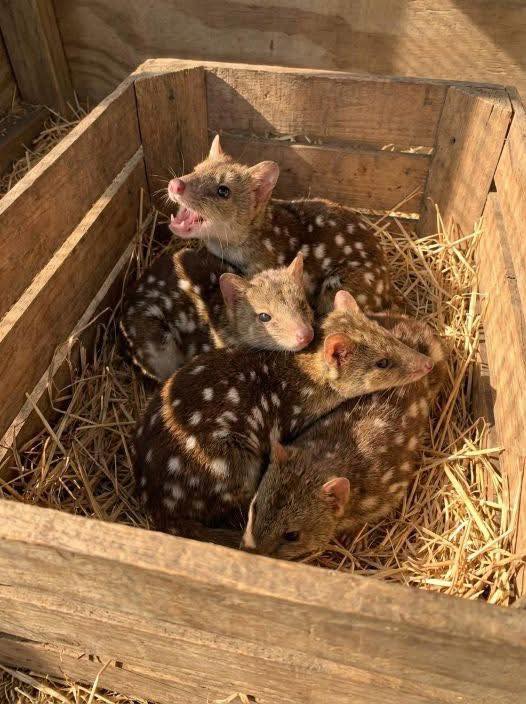
New life has burst into motion in a place that, not long ago, many believed had fallen permanently silent. In the vast red-dusted wilderness of Mount Gibson Wildlife Sanctuary, a small but fierce predator has stepped back from the shadow of extinction. Beneath the spinifex grasses and rocky outcrops, tiny bodies covered in speckled fur are beginning to stir, their bright eyes opening to a world their ancestors once ruled but nearly lost forever.
For decades, the fate of the Western quoll seemed sealed. Once widespread across much of Australia, this sharp-toothed marsupial hunter was pushed relentlessly toward disappearance. Habitat destruction, invasive predators, and poison campaigns meant to control other animals drove the species into a long, quiet collapse. Across huge stretches of the continent, their night calls vanished. The land that once echoed with their restless movement fell eerily still.
Many believed the story had already reached its tragic ending.
But in the protected heart of Mount Gibson, something extraordinary is unfolding.
Against the odds, a new generation of quolls has arrived.
Scientists and conservationists working within the sanctuary are now witnessing a moment they spent years hoping for but could never fully guarantee. A fragile litter of joeys—tiny, pink-nosed hunters with barely steady legs—has emerged from their mother’s den. Their presence signals something far bigger than a successful breeding event. It marks the first undeniable proof that the species is reclaiming ground it had lost for nearly a century.
Each squeak, each cautious step across the warm Australian soil, carries the weight of survival.
The sanctuary itself is part of an ambitious conservation effort led by the Australian Wildlife Conservancy, an organization dedicated to restoring ecosystems and rescuing species pushed to the brink. Years of preparation made this moment possible. Massive predator-proof fencing was installed. Invasive threats such as feral cats and foxes were relentlessly controlled. Native vegetation was protected and restored, creating a landscape where quolls could once again hunt insects, reptiles, and small mammals under the cover of night.
Only after all those conditions were met did conservationists dare to reintroduce the species.
Even then, success was far from guaranteed.
Leading ecologist Georgina Anderson and her team have spent long nights quietly tracking the animals’ movements through the sanctuary’s rugged terrain. Motion cameras flicker to life after sunset. Tiny radio transmitters reveal wandering paths through burrows and scrub. Every data point carries a mixture of hope and anxiety.
When the first images of newborn quoll joeys appeared on the monitoring equipment, the reaction among researchers was disbelief followed by quiet celebration.
It meant the animals were not merely surviving.
They were thriving.
Yet the victory is fragile.
Beyond the sanctuary’s carefully managed borders, the dangers that once drove the western quoll toward extinction still exist. Feral cats remain one of the most devastating predators for Australia’s small native mammals. Foxes stalk the landscape as well, efficient hunters introduced long ago that native species never evolved to evade. Climate extremes—from brutal heat waves to sudden drought—add another layer of uncertainty to an already delicate recovery.
The joeys now emerging into the world face a future filled with challenges.
But they also represent something powerful: proof that extinction is not always inevitable.
For conservationists, the sight of these tiny predators exploring their reclaimed territory feels almost symbolic. Each pawprint pressed into the red earth tells a story of resilience, patience, and the possibility of repair. A century of decline has not erased the instincts written into the western quoll’s bones—the urge to hunt, to survive, to multiply.
And now, those instincts are alive again.
Across Australia, where the country has witnessed the world’s highest rate of mammal extinction, the return of the western quoll carries a deeper message. It suggests that with enough protection, determination, and scientific care, even species pushed to the brink can claw their way back.
So the question hanging over Mount Gibson is no longer whether the quolls can return.
They already have.
The real question now is whether humans will fight just as fiercely to ensure this fragile miracle does not vanish again. In the quiet desert night, as the young quolls stumble forward on unsteady legs, the future of a species is unfolding one tiny footprint at a time. 🐾🌏✨