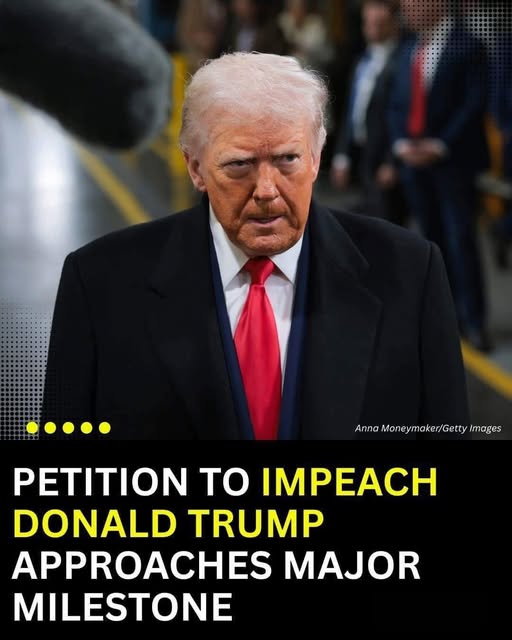
The anger didn’t disappear the day he left office—it simply changed shape.
What once erupted in rallies, headlines, and late-night arguments slowly settled into something quieter, colder, and more persistent. It didn’t fade. It organized itself. It moved online, gathered momentum in comment sections, group chats, and digital campaigns, until it found a single, simple outlet: a petition that is now racing toward 100,000 signatures.
On the surface, it looks ordinary—a basic online form, a count rising one click at a time. But beneath it, it has become something far more volatile: a symbolic flashpoint in an unfinished political story. For some, it represents long-delayed justice finally taking shape. For others, it is nothing more than a witch hunt dressed up as activism. Yet both sides are reacting to the same undeniable reality—Donald Trump continues to dominate America’s political imagination long after leaving the White House.
The petition, calling for his impeachment and circulated by the group Blackout The System, carries no legal authority. It cannot change policy, trigger proceedings, or force institutional action. And yet its power lies elsewhere—in visibility, in numbers, in the emotional weight of collective expression. Each signature becomes a small declaration of dissatisfaction, a digital mark of protest that says, in essence, the story is not finished.
Supporters describe it as a moral reckoning, a way to confront unresolved accusations of corruption, greed, and broken trust that still linger in public debate. Critics dismiss it as political theater, arguing that it repackages old grievances into an endless cycle of outrage. But even in disagreement, both groups participate in the same phenomenon: the transformation of political frustration into a measurable, public signal.
As the signature count climbs higher, the petition begins to represent something larger than its original purpose. It is no longer just about impeachment language or constitutional procedure—it becomes about memory, identity, and power in a deeply divided nation. In the digital age, activism no longer waits for elections or courtrooms; it unfolds in real time, shaped by clicks, shares, and viral momentum.
What emerges is a new kind of battleground—not of laws or ballots, but of narrative control. An online petition becomes a mirror reflecting how unfinished the debate remains, and how sharply the fault lines of American politics continue to cut through public life.