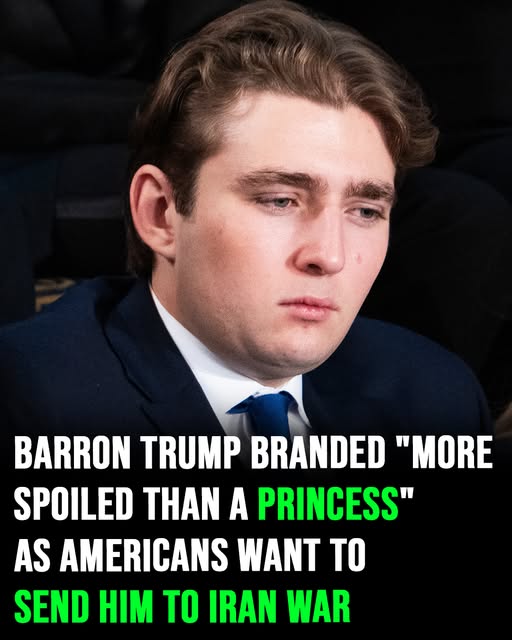
Social media didn’t just react—it detonated.
The moment American bombs struck Iranian targets, timelines flooded with outrage, fear, and fury. But within days, the conversation took a sharp, deeply personal turn. It wasn’t just about strategy, or consequences, or the widening shadow of war. It became about a name—Barron.
The hashtag #SendBarron surged across platforms, pulsing with anger and accusation. Strangers—many of them faceless behind screens—demanded that the president’s youngest son step forward and prove his patriotism in a conflict he did not choose. At just 20 years old, Barron Trump was suddenly thrust into a national spotlight far harsher than any campaign stage. He wasn’t being debated—he was being judged.
Then came the moment that poured gasoline on the fire.
On live television, Lawrence O’Donnell didn’t just critique policy—he made it personal. In a primetime monologue, he labeled Barron “more spoiled than a princess,” invoking history as both weapon and comparison. He pointed to the sons of Franklin D. Roosevelt, who served during World War II, and even to a teenage Queen Elizabeth II, who famously joined the Auxiliary Territorial Service. The implication was unmistakable: sacrifice, in times of war, should begin at home.
The backlash was immediate—and brutal.
To some, O’Donnell had voiced what many were already thinking: that a commander-in-chief should not be insulated from the human cost of decisions that send others into danger. As the conflict stretched into its second month, frustration had begun to shift. It was no longer confined to the Situation Room or Pentagon briefings. It seeped into kitchens, living rooms, late-night conversations—into the quiet spaces where ordinary Americans wrestle with the weight of distant wars that feel suddenly, uncomfortably close.
But the reality beneath the outrage is far more complicated than a trending hashtag or a viral monologue.
Barron Trump is not a soldier, nor a policymaker. And while his towering 6’7” frame might seem to fit the image of military readiness, it may actually place him in a gray zone under U.S. military medical and operational standards. Height restrictions can limit eligibility for certain roles—particularly in confined environments like tanks, armored vehicles, or aircraft cockpits. The image of him “heading to the front” is, in practical terms, far less straightforward than critics suggest.
Still, logic has struggled to compete with emotion.
For many, the argument isn’t about logistics—it’s about principle. It’s about the enduring belief that those who choose war should bear its weight most directly, that leadership should come with personal stakes, not distance from danger. And in that charged atmosphere, Barron has become something he never asked to be: a stand-in for a deeper frustration, a symbol onto which a divided nation projects its anger, its grief, and its unresolved questions about power, privilege, and sacrifice.
In the end, the most shocking twist isn’t what was said on television or what trended online.
It’s how quickly a young man, largely absent from public life, became the face of a war he didn’t start—and the focal point of a debate far bigger than himself.