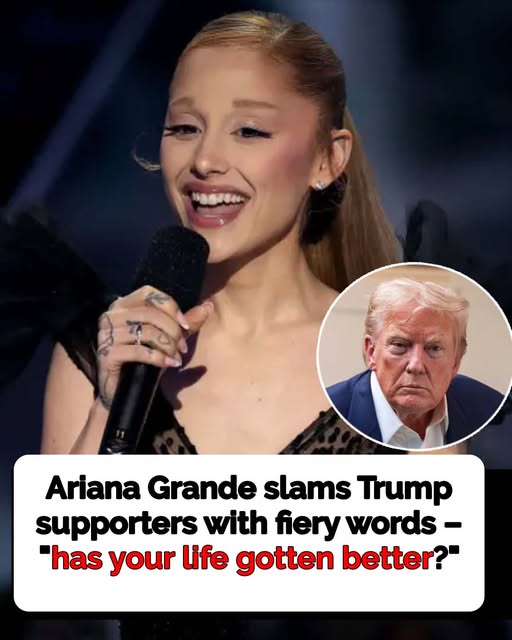
Ariana Grande just stepped into a storm she knew she couldn’t quietly walk away from—and this time, there was no soft landing.
With a single Instagram story, she didn’t just criticize Donald Trump. She drew a hard, unmistakable line—one that challenged not only his policies, but the people who stand behind him. It wasn’t phrased as a distant political opinion or a passing remark. It was personal. Direct. And for millions who saw it, impossible to ignore.
The post she shared, originally written by activist Matt Bernstein, didn’t soften its message. It asked a question that cut deeper than policy debates or campaign slogans ever could: Was it worth it? Were promises of lower grocery bills, cheaper insurance, or economic relief truly worth the fear carried by immigrants, the anxiety felt by transgender individuals, and the quiet suffering of those who feel pushed to the margins?
“Has the widespread suffering of others paid off for you… or are you still waiting?”
That single line spread like wildfire—shared, screenshotted, dissected. For some, it felt like a long-overdue moral reckoning, a celebrity using her massive platform to say what others were too cautious to voice. For others, it felt like a betrayal—an accusation aimed directly at fans who once adored her, now suddenly cast as part of the problem.
And then came the backlash.
It arrived fast, and it arrived loud. Social media flooded with anger, accusations, and calls for boycotts. Some critics labeled her ungrateful, others called her divisive, and a wave of outrage spiraled into something more extreme—demands that she be “deported,” despite the fact that she was born in the United States. The reaction wasn’t just disagreement; it was deeply emotional, reflecting how raw and polarized the political climate has become.
But this wasn’t unfamiliar territory for Grande.
She has never fully separated her voice from her values. Over the years, she has openly criticized Trump-era policies, voiced support for Kamala Harris, and even shared her heartbreak with fans after the 2016 election. With a global audience of over 370 million followers, she understands better than most that every word she posts carries weight—that a single sentence can ripple across continents and ignite conversations far beyond her control.
And yet, she continues.
Not because it’s easy—but because, for her, silence seems harder.
In a world where celebrities are often told to stay neutral, to protect their brand and avoid controversy, Grande is making a different calculation. She’s choosing to risk alienation in order to speak to what she sees as something bigger than popularity: conscience, accountability, and the human cost behind political decisions.
Whether people see her message as courageous or crossing a line, one thing is undeniable—she didn’t just post and move on. She forced a conversation many would rather avoid. And once a question like that is asked so publicly, so bluntly, it doesn’t simply disappear.
It lingers.