No one expected me to show up.
That was her plan from the beginning—carefully constructed, quietly cruel, and executed with a smile sharp enough to pass as kindness. No dress. No money. No mother standing behind me in the mirror telling me I was enough. Just the unbearable weight of being made visibly unwanted, of being positioned at the edge of someone else’s perfect story like a stain they were trying to ignore.
I was supposed to disappear gracefully. Break quietly. Accept the absence of everything I needed and call it maturity.
But she underestimated my brother.
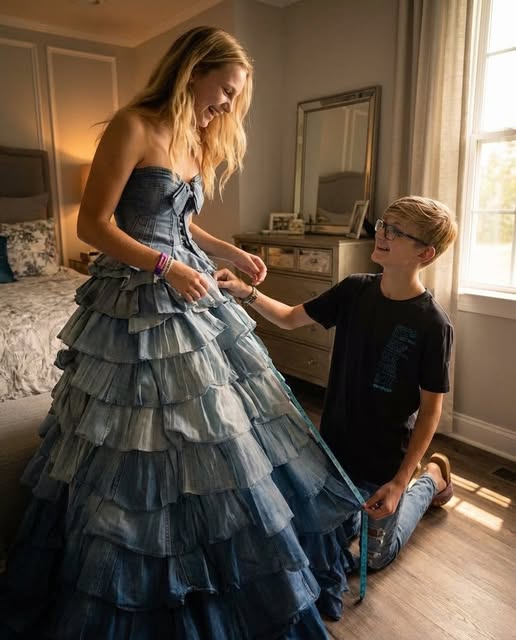
Noah walked through the door like a decision that couldn’t be undone. He didn’t bring sympathy. He didn’t bring speeches. He brought a stack of our mom’s old jeans—faded denim softened by time, frayed at the edges, still carrying the faint memory of her laughter in the way fabric holds scent long after it should have forgotten.
He dropped them on the table like a challenge.
“We’re not doing this her way,” he said simply.
And just like that, everything changed.
We didn’t just sew a dress.
We built something out of the ruins she left behind.
Noah worked like every stitch mattered more than the silence that had filled our house since Mom was gone. Every cut of denim felt intentional, almost ceremonial. He measured twice, not because he feared mistakes, but because he refused to treat this like anything less than sacred. I held fabric in place while he pinned it, and somewhere between the hum of the sewing machine and the soft rustle of worn jeans, something in me started to breathe again.
We worked in a quiet conspiracy—two people rebuilding a world in secret. Sometimes we laughed under our breath when a piece didn’t line up, sometimes we stopped entirely just to trace the stitching and remember where each pair of jeans had once been worn: Sunday errands, backyard gardening, road trips with music too loud and windows down.
It felt like she was there.
Not as absence—but as presence.
As if Mom was leaning over our shoulders, watching with that gentle pride she never got to fully voice, approving every bold cut, every stubborn seam, every refusal to let her memory fade into something fragile.
By the time the dress was finished, it no longer looked like denim.
It looked like history stitched into something unafraid.
Prom night came like a verdict I was ready to endure. I stood in front of the mirror expecting the familiar weight of judgment to settle over me—the whispers, the smirks, the satisfaction of people who had been taught to watch me shrink.
I expected humiliation.
I expected her victory.
Instead, I walked into a silence that broke for me instead of against me.
It started small—eyes lifting, conversations pausing, uncertainty giving way to curiosity. Then came the compliments, hesitant at first, like people weren’t sure they were allowed to admire me. Teachers asked about the design. Friends reached out to touch the patchwork panels as if they could feel the story woven into them. Even strangers—people who had never cared before—looked at me differently, like they were seeing something they hadn’t expected to matter.
And when they heard the truth—that the dress was made from my mother’s old jeans—the room shifted again.
Softened.
Some looked away quickly, blinking too hard. Others smiled like they were holding back tears they didn’t fully understand.
That night, Noah didn’t just make a dress.
He turned grief into armor.
He turned absence into presence.
And when I finally stepped onto the dance floor, I wasn’t wearing something meant to impress them.
I was wearing her memory—stitched carefully, stubbornly, beautifully around me.
And for the first time in a long time, I didn’t feel like someone trying to survive the room.
I felt like I belonged in it.