I had convinced myself that grief had finally loosened its grip on me—that it had softened into something quiet, something distant, like a storm that had long since passed. For years, it lived in the background of my days, no longer sharp enough to break me, just present enough to remind me of what once was. I carried it the way one carries an old photograph—carefully, respectfully, without expecting it to ever change.
But grief, I learned, does not always stay buried.
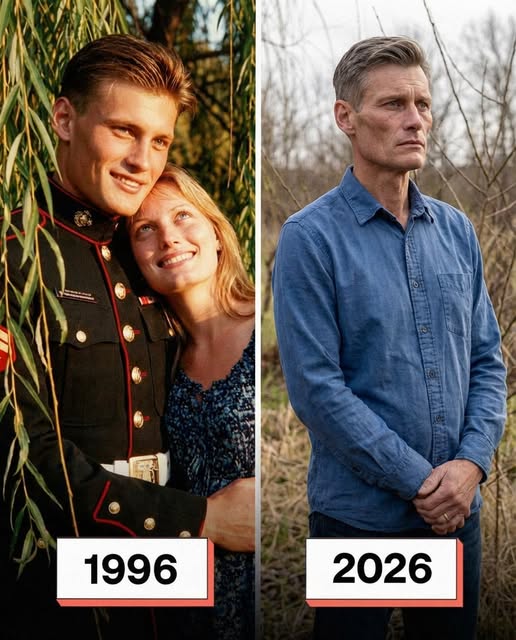
For thirty years, I returned to the same place—the willow tree at the edge of the field, its long, silver-green branches brushing the earth like fingers tracing memories. It became my ritual, my quiet act of devotion. Every year, every season, I stood beneath it and honored a promise that everyone else insisted had died with him. They told me to let go, to move on, to accept what the world had already decided was truth.
But I never could. Not fully.
And then, one cold February morning, when the air felt too still and the sky too pale, everything I thought I knew unraveled.
He was there.
Not a memory. Not a dream. Not a shadow shaped by longing.
Him.
The man I had mourned. The voice I had replayed in my mind until it blurred at the edges. The father my daughter had grown up without ever knowing. The man whose absence had shaped the very foundation of our lives.
I didn’t move at first. I couldn’t. It felt as though time itself had paused, holding its breath with me. The wind stirred, lifting the willow’s branches between us like a curtain unsure whether to reveal the truth or hide it once more. My heart pounded, but my body refused to follow.
Then he said my name.
Softly. Carefully. As if it were something fragile.
It was the same voice—the one that had once promised me, “I’ll come back.” The same voice I had heard only in dreams, echoing through years of silence. And in that moment, every version of him I had held onto—the memory, the ghost, the love I never buried—collapsed into the man standing in front of me.
His explanation didn’t come all at once. It came in pieces, scattered and imperfect, like fragments of a story that had been torn apart and stitched back together the wrong way. A mission gone wrong. Records lost, names misplaced. A letter written but never delivered. A life delayed by circumstances neither of us could control.
He had believed I chose to move on.
And while I was learning how to live with his absence—how to rebuild myself from the quiet ruins he left behind—he had been doing the same, somewhere far from me, carrying his own version of loss.
There was no anger at first. Just disbelief. Just the overwhelming weight of everything that had been stolen—not by choice, but by time, by silence, by a world that had moved us apart without asking.
But the hardest part wasn’t seeing him.
It was telling Stacy.
Our daughter had grown up with stories instead of a father. With questions instead of answers. I had watched her become strong in ways she never should have had to be, filling in the spaces he left behind without ever knowing what those spaces truly looked like.
When she finally stood in front of him, I held my breath the same way I had under the willow.
She didn’t run into his arms. There were no tears of instant joy, no perfect, cinematic reunion. Instead, she studied him—carefully, quietly—searching his face as if it were a mirror she had just discovered after a lifetime of not knowing her own reflection.
I saw it in her eyes—the recognition, the hesitation, the ache.
And I saw it in his too—the guilt, the longing, the fragile hope that maybe, just maybe, it wasn’t too late.
We didn’t try to pretend the years hadn’t happened. We didn’t try to reclaim what was lost, because some things cannot be returned, no matter how deeply we wish for it. There were no shortcuts to forgiveness, no easy words to mend decades of absence.
But there was something else.
Something quieter.
A choice.
Under the willow tree—the same one that had held my grief for thirty years—we stood together, not as the people we used to be, but as the people we had become. We acknowledged the years instead of erasing them. We let the truth exist, even when it hurt.
What remained wasn’t perfect. It wasn’t the life we had imagined all those years ago.
It was smaller. More fragile. More honest.
Three lives, no longer divided by silence or misunderstanding, finally allowed to exist in the same reality.
And somehow… that was enough.
Not to undo the past.
But to begin again.