I never loved him at first—not in the way stories are supposed to begin.
I married him out of exhaustion, not romance. I was tired in a way sleep could not cure. Tired of people leaving, tired of promises that dissolved before they could become real, tired of watching my own life slowly lose its color while everyone else seemed to move forward into something brighter. At some point, I stopped believing in the kind of love that arrives like lightning. I stopped waiting for it altogether.
And then there was James.
He wasn’t what I had once imagined I would choose. He didn’t arrive with confidence that filled a room or words that bent reality into something extraordinary. He limped slightly when he walked, as if life itself had once asked too much of him and he had simply learned to continue anyway. He still lived with his mother. He brewed tea instead of making grand declarations. He spoke softly, as though he never assumed the world owed him attention.
Nothing about him demanded to be loved.
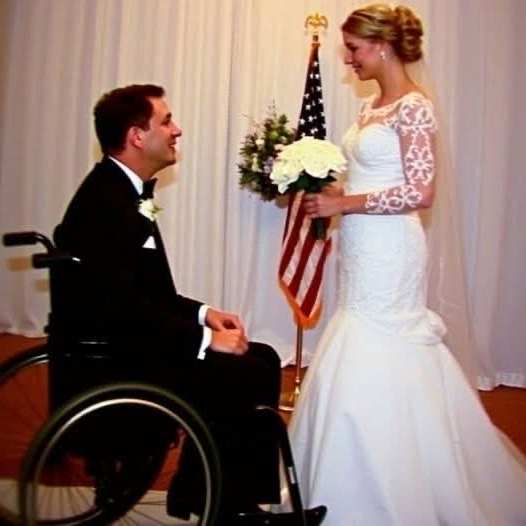
And yet, on the night I became his wife, he leaned close—not to claim me, not to promise me the impossible—but to speak a vow so quiet I almost missed it. It wasn’t polished or poetic. It was simple, steady, human. He said he would not rush me. He said he would not take more than I could give. He said he would stay, even if I had nothing left to offer but silence.
At the time, I didn’t realize how rare that kind of promise was.
I didn’t fall in love with James in a single moment. There was no dramatic turning point, no sudden revelation that rearranged my heart. Instead, love came to me slowly, almost reluctantly, disguised as ordinary days.
It was in the way he never touched me with expectation, only with patience. In the way he left a handwritten note beside my plate every morning, never dramatic, never ornate—just small reminders that I was seen. In the way he listened when I spoke, as if my words were not interruptions but important pieces of something he was carefully trying to understand.
He never tried to impress me. He never competed with my past or tried to erase it. He simply existed beside me with a quiet consistency that made my defenses feel unnecessary, even heavy. Over time, I stopped bracing myself every time someone came close. Over time, I stopped waiting for disappointment to arrive.
And somewhere between those unnoticed moments, I began to change.
It wasn’t dramatic. It didn’t feel like falling. It felt more like slowly exhaling after years of holding my breath.
Years passed like that—softly, almost invisibly. Our life together was not built on spectacle, but on repetition: shared mornings, quiet dinners, small routines that stitched themselves into something stronger than either of us could have planned. Love, I learned, was not always loud. Sometimes it was simply the decision to stay present, again and again, without asking to be rewarded for it.
Then came the hospital.
Machines replaced the familiar sounds of his presence. The man who had once fixed broken things with calm, patient hands could no longer fix his own failing body. Tubes, monitors, and steady electronic beeps became the language of our final conversations. And for the first time, I saw how fragile everything truly was.
I held his hand and realized I had once mistaken his gentleness for something small. It wasn’t small. It was deliberate. It was strength that never needed to announce itself.
When the end came, it did not arrive with drama or cruelty. It came quietly, like everything else in his life. His eyes softened, as if he recognized something I could not yet see. He smiled—not at me, but at something beyond me—and whispered something about cinnamon tea, as if even the smallest comforts of life were worth remembering until the very last breath.
And then he was gone.
What I understood only afterward was this: I had not been rescued by a grand love story. I had been given something far rarer. A love that did not demand I become someone else. A love that did not ask me to be fearless before I was ready. A love that waited patiently until I could meet it halfway.
He didn’t take my hope with him when he left.
He left it behind, quietly woven into every part of me he had ever touched.
And now, even in his absence, I carry it—not as pain, but as proof that something gentle can still endure, even after everything else has gone silent.