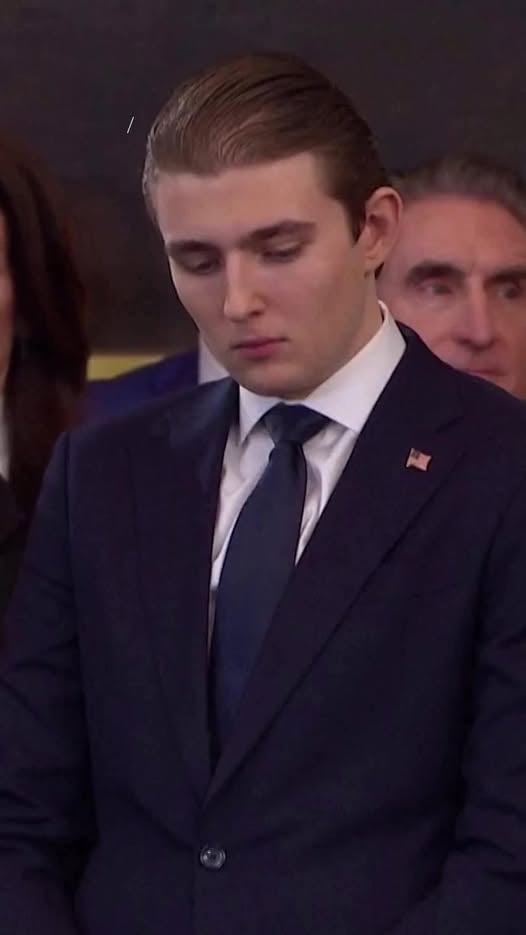
Barron Trump didn’t grow up in ordinary circumstances—he grew up inside a constant, shifting storm of attention, expectation, and controversy, where every member of his family was either a headline or a target. Yet somehow, in the middle of that noise, he learned something unusual: how to stay still.
While his father dominated the public stage with rallies, interviews, confrontations, and an unending cycle of political and media battles, Barron was being shaped in an entirely different environment—one defined less by performance and more by restraint. There were no slogans crafted around him, no public image carefully marketed for approval, no pressure to become the next loud continuation of the Trump name. Instead, his upbringing seemed almost intentionally pulled away from the spotlight, as if silence itself was a form of protection.
At the center of that world stood his mother, who treated visibility not as a prize but as a risk. She emphasized privacy over publicity, discipline over display, and distance over constant exposure. In that atmosphere, Barron learned early that not everything needed to be shared, and not every moment needed an audience. Manners mattered. Control mattered. Emotional boundaries mattered. And perhaps most importantly, invisibility—when chosen—could be a form of strength rather than absence.
The public, of course, never quite knew what to make of him. People searched for clues: Was he a future political figure in the making? A hidden extension of his father’s ambitions? A symbol of legacy waiting to be activated? But Barron never stepped forward to answer those questions. He did not offer a narrative for others to consume. He did not shape himself into expectation. Instead, he remained carefully out of reach, allowing speculation to grow while revealing almost nothing in return.
What emerged over time was not a public persona built on speeches or appearances, but something far more elusive: a young man defined by restraint. Barron’s presence is marked less by what he says and more by what he refuses to give away. In a family known for dominance, boldness, and constant visibility, his defining trait became the opposite—containment.
That kind of upbringing did not train him for spectacle; it trained him for composure. He learned to observe rather than react, to absorb rather than broadcast, to decide carefully rather than impulsively. And in doing so, he developed a quiet kind of authority that does not depend on volume to be felt.
Now, as he steps further into adulthood, there is no grand unveiling, no orchestrated public transformation, no attempt to convert his name into a performance. Instead, there is continuity—a steady extension of the same guarded, deliberate distance that has followed him since childhood.
In a family built on visibility, controversy, and the expectation of constant expression, Barron Trump’s greatest distinction may be his refusal to participate in that cycle at all. Not through rebellion, and not through rejection, but through something far rarer: calm, intentional silence.
And in a world that constantly demands to see, explain, and define him, that silence may be the most powerful statement of all.