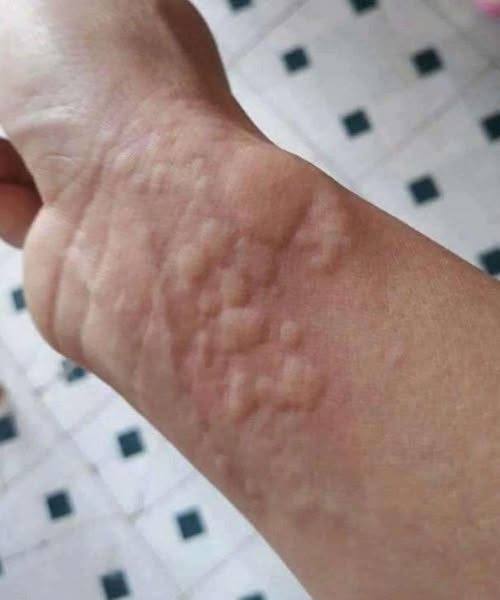
Most people dismiss it without a second thought—a red welt appearing on the skin, an itchy patch that comes and goes, or a strange rash that seems to appear out of nowhere for no clear reason. It looks harmless at first glance, almost like a minor irritation the body will “fix itself.” But sometimes, what appears on the surface is only the visible edge of something far more serious unfolding beneath it.
When those raised, red, swollen marks—commonly known as hives—show up alongside even the slightest difficulty in breathing, the situation changes completely. A mild tightness in the chest, a scratchy or constricted throat, a sudden wheeze, or swelling of the lips, tongue, or face are not random symptoms. They can be warning signals that the body is entering a dangerous allergic reaction. Especially for people over 60, this combination can escalate rapidly, sometimes in minutes, without much warning.
What makes it even more alarming is how unpredictable it can be. An immune system that once tolerated certain foods, medications, or environmental triggers for years can suddenly shift. Something you have eaten your entire life, a medicine you have taken without issue, or a familiar exposure in your home or surroundings can suddenly become the spark for a severe reaction. The body does not always announce these changes gently—it reacts when least expected.
In some cases, hives are not just a skin condition at all. They can be part of a larger, full-body emergency known as anaphylaxis—a powerful allergic “storm” that affects breathing, circulation, and vital organs. It is not just discomfort; it is a medical emergency that demands immediate attention. The danger lies not only in the reaction itself, but in how easily its early signs can be underestimated or mistaken for something minor.
This is why hesitation becomes the greatest risk. Waiting to “see if it passes,” trying to push through symptoms, or assuming it is only a skin issue can cost precious time. If breathing becomes difficult, if swelling begins to spread, or if symptoms intensify quickly, immediate action is essential. Calling emergency services without delay and using a prescribed epinephrine auto-injector, if available, are not dramatic responses—they are life-saving decisions.
After 60, awareness becomes one of the most powerful forms of protection. Listening closely to the body is not fear or overthinking; it is experience, wisdom, and self-preservation. Recognizing that a “simple rash” can sometimes signal something far more serious may be the difference between safety and crisis.
Share this knowledge. It may help someone notice the warning signs in time—and act before it is too late.