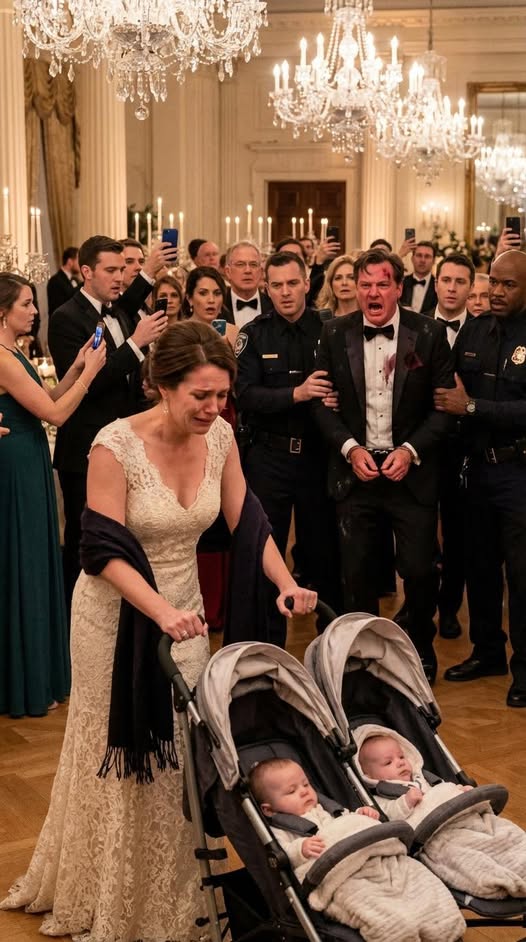
The silk of my dress caught against the thin line of my old scar as I moved through the room, a sharp reminder of everything I had survived long before tonight. Around me, the air shimmered with champagne laughter and polished conversations, the kind of curated elegance my husband loved to perform in. He stood at the center of it all—perfect posture, easy smile, rehearsed charm—calling me a “liability” between toasts as if I were nothing more than a misplaced detail in his otherwise flawless story.
I watched him lift his glass to a future he believed he had built alone. He spoke of success, of vision, of legacy—words that sounded convincing to everyone who had never bothered to look closely. No one in that room questioned the invisible scaffolding beneath his empire. No one asked whose name quietly anchored every contract, whose signature stabilized every loan, whose family wealth had once transformed risk into opportunity. And certainly no one asked why, despite all his confidence, he had never truly owned any of it.
He never realized I was not background. I was infrastructure.
While he entertained admirers and soaked in applause, I sat alone in a quiet corner of the hotel suite upstairs, holding our sleeping children close as the world I had built under his feet began to shift. My phone glowed softly in the dark—no shouting, no confrontation, no spectacle. Just decisions made in silence. Accounts frozen. Access withdrawn. Legal switches flipped with the same precision that had once been used to protect him. The empire he believed was his inheritance of brilliance was, in truth, a structure carefully maintained by hands he never bothered to respect.
Downstairs, the celebration continued. Up here, everything changed.
By the time the Board convened without him, the illusion had already begun to collapse. They didn’t see a discarded wife stepping into conflict—they saw the majority shareholder finally stepping into visibility. I entered the room without urgency, without performance, without the need to prove anything to people who had mistaken silence for absence. The documents were already aligned. The votes already secured. The outcome already decided long before I crossed the threshold.
When it was over, there was no eruption, no dramatic collapse—only the clean finality of truth taking its place. He was removed not in fury, but in procedure. Not in chaos, but in order. And for the first time in years, I felt the strange, steady weight of my own life returning to me—not as something I was supporting from behind the curtain, but something I was finally allowed to live in full light.
Freedom didn’t arrive like a storm. It arrived like silence after noise—like a signature drying on paper, like a cab door closing softly behind me, like my children breathing evenly in the backseat while the city blurred past the window.
And as I looked out into the night, I understood something simple and irreversible: he had never lost control in a single moment.
He had simply never had it at all.