The doorbell didn’t ring.
It struck—sharp, urgent, almost violent in the way it shattered the fragile silence of the morning.
For a split second, I just stood there, frozen in the hallway of the house I was still learning to believe belonged to me. I already knew, before my hand even touched the doorknob, that this wasn’t a friendly visit. Nothing in my life had ever been that simple.
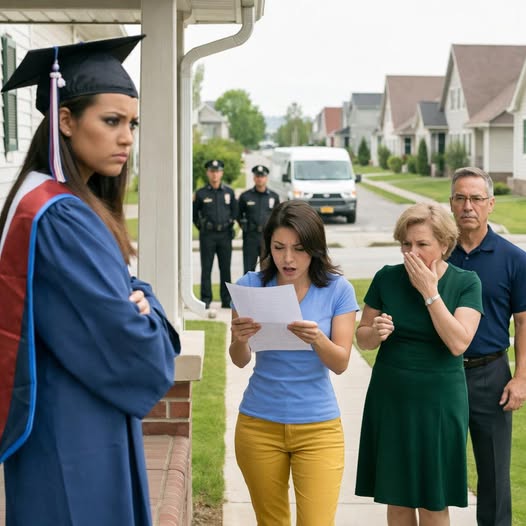
When I finally opened the door, the scene outside felt like something staged for a nightmare I used to have as a child but thought I had outgrown.
My parents stood closest, dressed in that familiar armor of control and entitlement, the same look they always wore when they believed the world owed them obedience. Behind them was my sister Ashley—my so-called “golden child,” the one who never had to fight for approval because it was always handed to her like inheritance. And beside them, a moving truck idling at the curb like it already belonged there.
They weren’t just visiting.
They were here to take.
Boxes were stacked. Labels were ready. And in my father’s hand—calm, deliberate, almost proud—were documents that were not just questionable, but forged. Their plan wasn’t hidden behind hesitation or doubt. It was rehearsed, polished, and disturbingly confident, like they had already lived through my resistance and decided it didn’t matter.
They had come to erase me from my own ending.
To them, this wasn’t theft. It was correction. A “restoration” of what they believed should never have been mine in the first place—my grandparents’ house, my future, and the first real proof that I had ever been chosen for something without conditions attached.
And yet, what they didn’t know—what they had never bothered to know about me—was that I had stopped being the version of myself they could easily overwrite.
I had spent my entire life inside a system where love was never given freely. It was measured, rationed, and withdrawn the moment I failed to meet invisible expectations. In that system, fairness wasn’t a rule—it was a privilege reserved for Ashley, who floated effortlessly through childhood on a current of excuses and forgiveness that never extended to me.
I learned early how to survive it.
How to shrink myself so I wouldn’t be blamed for taking up space. How to stay quiet enough not to trigger anger, but alert enough to predict it. How to prepare for disappointment so often that hope itself felt like a risk I couldn’t afford.
My grandparents were the only exception to that rule.
They saw through all of it—the imbalance, the favoritism, the quiet erosion of my confidence. And instead of dismissing it, they did something no one else ever had. They believed me. Not just my words, but my silence, my effort, my resilience. They understood that what my family called “difficulty” was actually endurance.
And in the end, they made a choice that changed everything.
They left me the house. Not just as property, but as a statement. A declaration that I was not invisible. That I was not disposable. That I was, finally, chosen.
To protect it, I didn’t rely on hope. I relied on structure. On law. On something stronger than emotion or manipulation. The trust they helped establish was irrevocable, carefully designed, and airtight in a way my family never bothered to understand because they never imagined they would need to.
So when they arrived with forged documents and a moving truck, expecting the same outcome they had always gotten—compliance, surrender, silence—they walked straight into something they hadn’t prepared for.
My lawyer was already there.
So was the sheriff.
And behind them was a legal reality that no amount of guilt, shouting, or rewritten history could bend.
The confrontation didn’t explode the way I think they expected it to. There was no dramatic begging, no last-minute reversal. Just the slow, unmistakable collapse of certainty as their version of the story stopped working in real time.
I watched it all from the edge of the doorway, not as someone trying to win, but as someone finally no longer willing to lose.
When the charges were mentioned, it didn’t feel like triumph. There was no rush of satisfaction, no clean sense of justice settling into place. Instead, there was something quieter. Heavier. Like stepping out of a storm you didn’t realize you had been standing in your entire life.
I didn’t fix them. I didn’t redeem them. I didn’t turn pain into forgiveness for anyone else’s comfort.
I simply chose myself.
And later, when the moving truck was gone and the driveway was empty again, I stood inside the house they had tried to take—listening to how still it was, how real it felt—and understood something I had never been allowed to believe before:
Not everything you survive is meant to be carried forward.
Some things are meant to end with you.