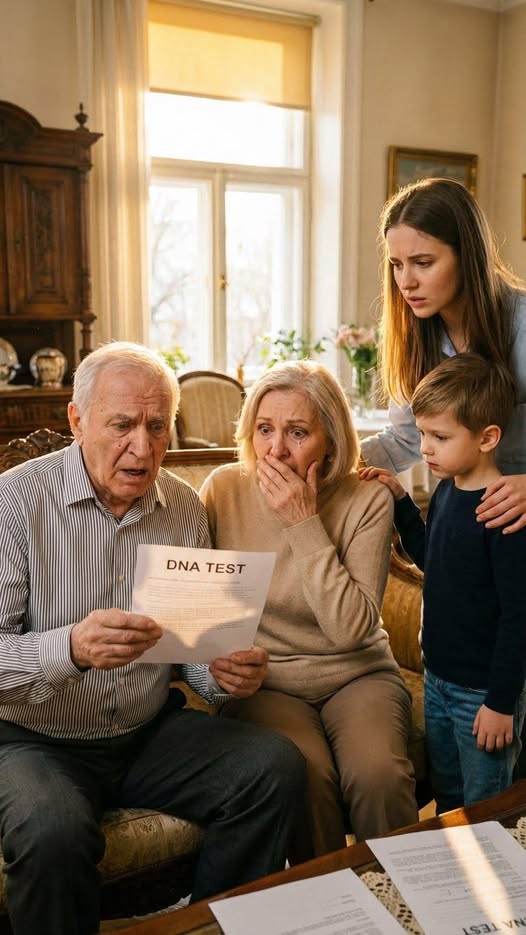
The first time I carried my son across that threshold, it felt like stepping into a room where time had never truly moved on. The house looked exactly the same—same walls, same faint scent of old wood and memories—but it no longer felt like home. It felt like a place suspended in what was left unsaid. Every corner seemed to hold echoes of conversations that never happened, apologies that were never offered, and truths carefully locked away for far too long.
My parents were already waiting. And the moment their eyes landed on him, I saw it—not joy, not curiosity, but a sharp, involuntary flinch. Not at my child, but at what he represented. At what he proved. Ten years of silence tightened in the air like a wire pulled too taut, humming with a tension no one in that room had ever been brave enough to name. They had spent a decade building a version of reality that made them comfortable. And in a single breath, my son quietly unraveled it.
They had once called it a mistake. A rumor. A chapter best left closed. They had chosen selective memory over truth, convenience over accountability. But they never imagined that the truth would grow up, learn to walk, and look just like him.
When I finally spoke his name, it didn’t feel like I was introducing him. It felt like I was breaking a seal.
Robert Keller.
The name landed in the room like something heavy finally dropped after being held in the air for years. My parents didn’t respond right away. They couldn’t. I watched the subtle collapse of their certainty—the tiny betrayals of expression, the tightening around their mouths, the flicker of recognition they had tried so hard to suppress. Because Robert Keller was no longer the charming family friend they once defended at dinner tables and gatherings. He was no longer a protected memory softened by time and denial.
He was the man who had taken my choice before I was ready to understand what choice even meant. The man who had reshaped my life in ways they never wanted to name aloud. And in that moment, standing in the middle of their carefully preserved world, I was no longer their obedient daughter or their uncomfortable secret.
I was the consequence they had never prepared for.
My son, however, did not break the silence with fear or confusion. He stood beside me with the quiet steadiness only children possess when they trust the hand holding theirs. He didn’t shrink under the weight of the room’s history. He didn’t ask permission to exist. He simply was—whole, unshaken, and real in a space that had once tried to erase his possibility entirely.
It was that stillness in him that made the room shift even further. Not anger. Not accusation. Just truth, undeniable and alive.
What followed was not the kind of reconciliation people write about in stories. There were no sudden embraces, no perfect apologies that healed everything in an instant. Instead, it unfolded slowly, unevenly—like something fragile being handled for the first time after years of neglect.
My father spoke first, and his voice didn’t carry authority anymore. It cracked under the weight of everything he had avoided facing. He didn’t defend himself. He couldn’t. For the first time, he admitted what silence had cost, and in that admission, I saw not redemption, but reckoning.
My mother followed more quietly. Her hands trembled as she reached toward her grandson, hesitating as if unsure whether she had the right to touch what she had emotionally refused to acknowledge for so long. When she finally did, it wasn’t forgiveness that passed between us—it was recognition. The kind that arrives too late, but still arrives.
I didn’t forgive them because they finally deserved it. I forgave because I understood something deeper in that moment: holding onto their refusal to face the truth would never undo what had already been done. It would only keep me tied to it.
And I was done being tied to it.
So I stood there—in the house that had once shaped me, silenced me, and failed me—and I chose something different. I chose my son. I chose my voice. I chose the life that stretched beyond their approval or understanding.
And when I finally walked out of that doorway again, I wasn’t carrying the weight of their past anymore.
I was carrying something far stronger: the certainty that I had finally become someone they could no longer define.