Some loves don’t arrive gently—they are carved out of chaos, tested in heat, and proven in the kind of moments most people never survive. Mine began in fire. Not metaphorical fire, but real flames swallowing a home, smoke thick enough to erase the world, and a night that should have ended everything before I even had a chance to remember it.
I was just a baby when it happened—too small to understand danger, too small to even cry properly—but not too small to be saved. My grandfather ran into that burning house when others were running out. I’ve been told he didn’t hesitate. Didn’t think. Didn’t weigh risk against reward. He simply went in. And when he came back out, coughing, staggering, skin scorched and lungs fighting for air, he was holding me tightly against his chest as if letting go was not an option the world was allowed to offer.
That was the first promise he ever kept to me: I will not leave you behind.
But the fire didn’t just take aim at the house. It took pieces of him too. His child was gone. His home was gone. The life he had built, the future he had imagined, all reduced to ash and silence. Most people would have been allowed to break under that weight. But he didn’t. Or maybe he did, quietly, in places no one could see. And still—somehow—he rebuilt.
Not a perfect life. Not an easy one. A patched-together life. A life stitched from exhaustion and stubborn love, from mornings when getting out of bed was a decision and nights when sleep didn’t come easily. And at the center of it all… was me.
He learned how to raise a child while carrying grief like a second spine. He showed up with crooked braids because his hands were too rough and too tired to do them neatly. He burned dinners and called it “adventure.” He sat in uncomfortable chairs at school events, clapping louder than anyone else in the room. He turned ordinary moments—breakfast, homework, scraped knees—into proof that love doesn’t need to be perfect to be real. It just needs to stay.
Then came the stroke.
It took more than his body. It stole his balance, his independence, the easy dignity of movement. It tried to reduce him to silence and stillness. But even then, it couldn’t touch the one thing that defined him: his presence. Because he still showed up. In small ways. In difficult ways. In ways that required more courage than most people will ever be asked to give.
And I watched him do it.
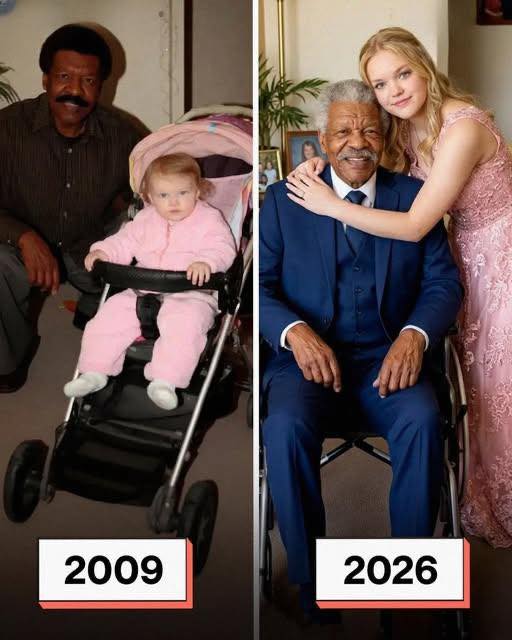
Years passed like that—life narrowing, then widening again in unexpected ways. And somewhere along the way, prom night arrived. The kind of night people imagine as light and effortless. Dresses, music, laughter, photographs that pretend life is simple. For me, it wasn’t simple at all. Because I knew he wanted to be there more than anything—and I also knew it wouldn’t be easy for him.
When he arrived at the gym in his wheelchair, everything seemed to pause. The noise didn’t stop immediately, but it changed. Whispers started first—confused, uncertain, judgmental in the way teenagers sometimes are when they haven’t yet learned how fragile life can be. A few laughs followed, careless and sharp.
But then he rolled forward.
And something shifted.
Because people don’t expect dignity to look like that. They expect it to be loud, polished, standing tall. Not quiet. Not worn. Not sitting in a wheelchair after surviving fire, loss, and a lifetime of rebuilding. But dignity doesn’t always announce itself. Sometimes it just enters a room and changes what the room is allowed to be.
The whispers died. The laughter disappeared. Even the music seemed to hesitate.
And then he reached me.
I don’t remember the exact words we said. I don’t think there were many. Some moments don’t need language—they already carry everything that matters inside them. When I helped him onto the floor for our dance, it wasn’t about prom anymore. It stopped being about the crowd, the lights, the expectations of a perfect teenage night.
It became something much older.
A lifetime folded into a single song.
In that slow movement, I could feel everything he had ever done for me. The smoke he walked through. The grief he carried quietly. The mornings he forced himself to smile. The nights he stayed awake just to make sure I was safe. The way he rebuilt a broken world without ever asking for recognition.
And I realized something I had always known but never fully understood until that moment:
Some people search their entire lives for unconditional love. I never had to.
Because mine didn’t just come to me.
It carried me out of the fire… and then kept showing up, every single day after.