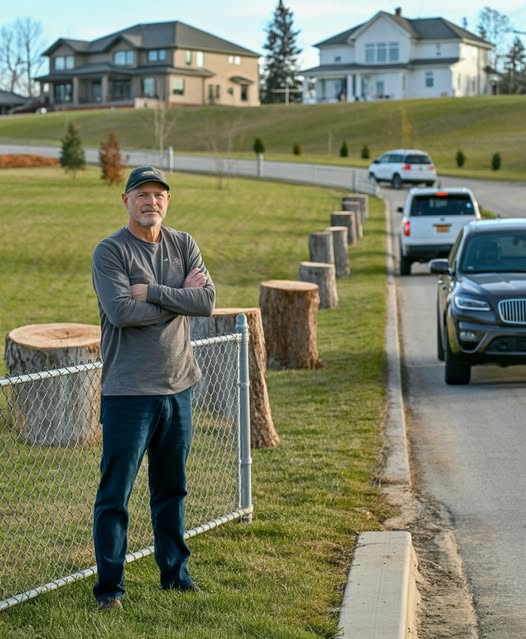
They didn’t just cut down trees that day. They erased a living memory—something that had stood quietly for decades, offering shade, shelter, and the kind of comfort people only notice once it’s gone. It wasn’t just wood and leaves that fell under the chainsaws. It was my father’s presence in that land, the slow, steady proof that he had once built something worth returning to.
The machines didn’t hesitate. They never do. By the time anyone thought to ask questions, the trunks were already stacked, the branches already reduced to debris, and the air already stripped of something it could never quite replace. Neighbors watched from a safe distance, some nodding politely, others pretending it wasn’t their concern at all. Words like “development,” “compliance,” and “easement rights” floated around like shields, carefully polished phrases meant to make destruction sound reasonable. Progress, they called it. Nothing personal, they insisted.
But that wasn’t true. Not even slightly.
Because the land remembers what people try to forget. The soil remembers the weight of roots that once held it together. The wind remembers the way shade used to fall across that path in the late afternoon. And I remembered my father standing there years ago, saying nothing dramatic, just placing his hand on one of those trunks like he already knew time would eventually ask for too much.
I didn’t react the way they expected.
They expected noise. Anger. Maybe a useless confrontation that would burn itself out against paperwork and polite indifference. Instead, I went quiet. And in that silence, I started reading.
Every document, every recorded line, every forgotten clause in that easement became something else entirely—not legal jargon anymore, but a map. A map of permissions they thought they fully understood. A map of boundaries they assumed would never be questioned. And somewhere inside that stack of paper, I found something my grandfather had signed long ago, in a moment that must have seemed insignificant at the time. A simple mark. A quiet agreement. The kind of detail people forget—until they need it.
That signature became the turning point.
I didn’t need to raise my voice. I didn’t need to argue with people who had already decided they were right. I only needed to stand exactly where the lines on that document said I could stand, and understand what it meant for everyone who had been driving across it without a second thought.
When I finally acted, it wasn’t dramatic. It wasn’t loud. It was precise.
Access changed. Routes shifted. What had once been taken for granted became something that required acknowledgment. Tires that used to pass freely now had to slow, turn, reconsider. The smallest inconvenience began to accumulate—not as punishment, but as truth finally catching up with assumption.
And the strange thing was, I never once had to raise my voice for it to be felt.
They called the county. Of course they did. But the confirmation that followed wasn’t a victory parade for me—it was simply the world aligning itself back into its correct shape. A boundary that had always existed was now impossible to ignore. The conversation was no longer about emotion or outrage. It was about facts. Lines. Ownership. Reality.
Eventually, they sat across from me.
Gone was the easy confidence they had carried when the trees were still falling. Gone was the assumption that I would remain passive, that grief would stay silent and harmless. In its place was something quieter on their side of the table—calculation mixed with discomfort, the realization that the story had more than one layer.
They spoke of compensation. Of settlement. Of repair.
But money doesn’t rebuild a canopy that took decades to grow. It doesn’t return the shade that once marked the passing hours of a life. It doesn’t bring back the sound of wind moving through branches that no longer exist.
Still, something did change in that room. Not justice exactly. Not healing either. But recognition. The kind that settles into people when they realize that actions, even legal ones dressed in paperwork, still carry consequences that don’t disappear when the ink dries.
Afterward, I planted new saplings.
They are thin compared to what was lost. Fragile in a way that almost feels unfair. But they stand where the old trees once stood, not as replacements, but as markers. Quiet declarations written in green instead of stone.
This far, they say without words.
This far, and no farther.
And never again without asking.