The knock came at a moment when the house had just begun to exhale again—softly, cautiously, like it wasn’t sure it was allowed. Grief had loosened its grip, if only by a fraction. The sharp edges of loss had dulled into something quieter, something that lived in the background instead of swallowing every breath. She had started to believe, hesitantly, that the worst had already passed. That whatever had been taken from them had been taken completely.
She was wrong.
Because grief, she would soon learn, doesn’t only take. Sometimes, in the most unexpected ways, it gives something back—reshaped, reimagined, and almost too fragile to notice at first.
Her son had been working in silence for weeks.
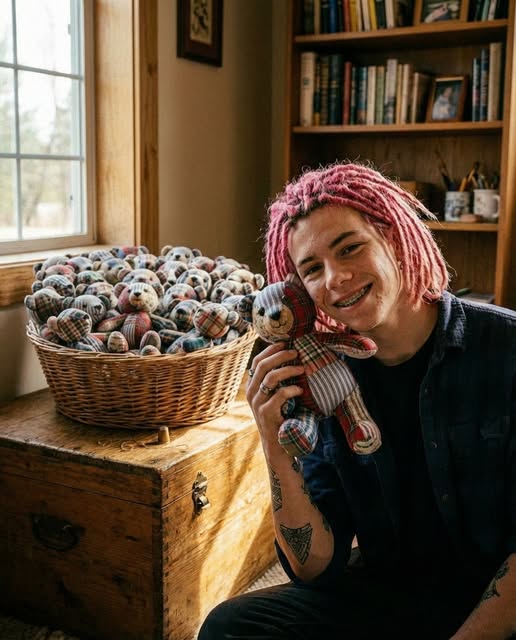
At the kitchen table where his father used to sit, where laughter once filled the evenings and routines felt permanent, he now stitched carefully, deliberately. Old shirts—soft with wear, carrying the faint memory of a life that once moved inside them—became something new beneath his small, steady hands. He didn’t talk much while he worked. He didn’t need to. Each thread, each careful seam, said what words could not.
She thought it was just his way of coping. A private ritual. A quiet conversation between a boy and the father he missed too much to name out loud.
She never imagined it would travel beyond their walls.
After their visit to the shelter, life fell into a delicate rhythm. Not whole, not healed—but moving. Mornings came. Meals were made. Days passed. And at that same table, her son kept sewing, turning grief into something soft enough to hold. Something that could be hugged. Something that didn’t disappear when the lights went out.
She assumed, like so many small acts of kindness, that it would remain just that—small. Meaningful, but contained. A moment that would fade gently into memory, tucked among all the others that marked their journey through loss.
But compassion has a way of refusing to stay still.
It moves. Quietly at first. Then farther than anyone expects.
The knock on the door, when it came, didn’t carry the weight of dread anymore. Still, her chest tightened as she opened it—some habits of grief linger longer than others.
On the other side stood unfamiliar faces.
Staff from the shelter. And beside them, two parents she had never met—eyes tired in a way she recognized instantly, hands clutching something precious. They weren’t there with condolences. They weren’t there with pity.
They were there with something else entirely.
Gratitude.
They stepped inside, carrying photographs carefully protected in worn envelopes. Letters written in uneven, trembling handwriting. Stories that spilled out in halting voices—about children who had lost too much, too soon. Children who now slept with something soft held tightly against their chests.
Bears.
Not just toys, but pieces of someone they had loved. Something that still felt like them. Something that stayed.
Her son stood quietly as they spoke, his hands still, his eyes wide. He hadn’t realized what he had made. Not fully. Not yet.
The parents explained how those bears had changed their nights. How fear softened. How silence felt less empty. How grief, for a few hours at a time, felt bearable.
And then came the question.
It was simple. Gentle. But it carried the weight of something much larger than any of them.
Would he be willing to make more?
There were others, they said. Other families holding onto closets they couldn’t open. Other children searching for something—anything—that still felt like the person they had lost. They had clothing, memories woven into fabric, waiting for a second life.
In that moment, something shifted.
The house no longer felt like a place defined only by absence. The grief that had once sealed every door now seemed to open them instead. Windows, too. Letting something new move through—something fragile, but alive.
Her husband’s shirts were gone. That much was true.
But what they carried hadn’t disappeared.
It had simply changed form.
Now, it lived in careful stitches. In soft seams shaped by small hands. In bears that traveled from one grieving heart to another, carrying comfort where words could not reach.
What began as a boy’s quiet way of holding onto his father had become something far larger than either of them could have imagined.
A thread of kindness, passed on.
A legacy, rebuilt piece by piece.
And through her son’s hands, their love—once confined to a single home—kept finding new places to rest, new arms to hold it, new hearts to keep it alive.