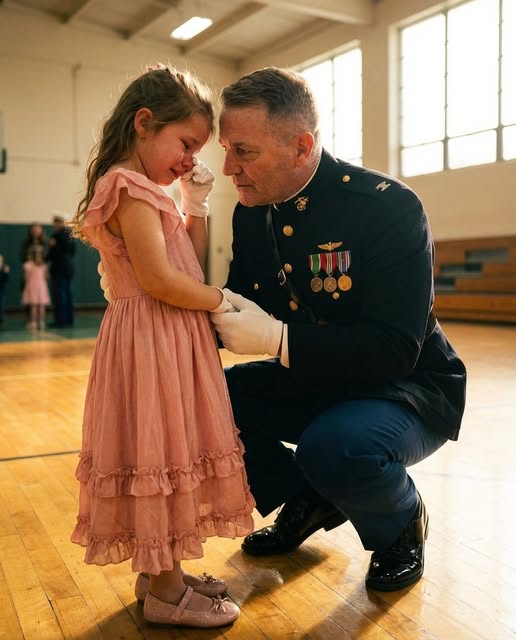
The music was too loud for a night carrying this kind of ache. It filled every corner of the gym, bright and relentless, as if joy could be turned up high enough to drown out absence. But it couldn’t. Every laugh that burst across the room, every pair of shoes gliding across the polished floor, only sharpened the outline of who wasn’t there. The space beside us felt louder than the speakers, heavier than the bass. And when my daughter looked up at me and quietly asked if it still “counted” without her dad, the question didn’t just land—it stayed, echoing in my chest like something broken that didn’t know how to heal.
I had walked into that gym prepared to endure, not to be changed. Survival—that was the goal. Just get through the night without letting the grief spill over, without letting her see how unsteady I still was. We found a place along the wall, slightly removed, like we were watching a life we used to belong to. Around us, fathers knelt to adjust tiny shoes, spun their daughters in dizzy circles, laughed in that easy, unguarded way that comes from knowing this moment will be remembered forever.
My daughter’s hand tightened around mine, small but desperate, as if holding on could keep her from drifting too far into that quiet place grief builds—a place where the world keeps moving, but you don’t quite feel part of it anymore. Her eyes followed every dance, every twirl, every moment she wasn’t having. I could feel it happening in real time—the slow retreat, the soft dimming of something that should have been shining.
And then, something shifted.
The gym doors opened.
At first, it was just a sound—the creak, the pause in movement, the subtle turning of heads. Then they stepped in. Uniforms. Quiet strength. Presence. The kind that doesn’t demand attention but somehow gathers it anyway. The room didn’t erupt; it softened. Conversations hushed, music seemed to fade into the background, and something unspoken passed through the crowd like a shared understanding.
One of them walked toward us—not hurried, not hesitant, just steady. There was a gentleness in the way he approached her, as if he knew this wasn’t just a dance. This was sacred ground. This was a moment balanced between heartbreak and something else… something waiting to be born.
He knelt slightly to meet her eyes, not towering over her but meeting her where she was. When he spoke, it wasn’t loud, but it carried.
They were there for her.
They were there to honor her dad.
And just like that, something inside her shifted.
It was small at first. A straightening of her shoulders. A breath she hadn’t realized she was holding finally released. Then her fingers loosened from mine, not because she was letting go—but because she was ready to reach for something new.
He offered his hand.
She took it.
And when they stepped onto that dance floor, the night changed.
She laughed—really laughed—for the first time since we walked in. Not the careful kind, not the polite kind, but the kind that rises up without permission. Her feet found the rhythm. Her smile found its way back. And as the music swelled around them, she wasn’t the girl sitting against the wall anymore, measuring her loss against everyone else’s joy.
She was dancing.
Surrounded by people who didn’t know her story in full, but chose to honor it anyway. Men who didn’t have to be there, who owed us nothing, but showed up with everything that mattered. Presence. Kindness. Recognition. Love, in its quiet, powerful form.
I stood there, watching her spin under the lights, and something inside me broke open—not in pain, but in understanding.
We hadn’t lost everything.
Love hadn’t ended.
It had simply changed its shape.
It found its way through strangers. Through courage. Through the simple, profound act of showing up. And in that moment, I realized something I hadn’t been ready to admit before:
Even in the deepest absence, love keeps arriving.
Sometimes, it just walks through the door when you least expect it.