The wedding morning didn’t unravel slowly—it shattered in a single, merciless heartbeat.
Twenty-three people filled the house, their voices rising in bright, careless laughter. Glasses clinked. Music hummed. Someone called for more flowers, another for the missing cufflinks. It was the kind of chaos every wedding morning wears like a badge of honor—alive, hopeful, loud with expectation.
And yet, in the middle of it all, my daughter was breaking.
Not one of them heard it.
Not the guests drifting between rooms, not the bridesmaids chasing mirrors and mascara, not even me—not at first. Her heartbreak didn’t announce itself. It hid. It folded inward. It locked itself behind the thin wooden door of a laundry room, where joy couldn’t reach and no one thought to look.
That’s where I found her.
The world outside was still laughing when I opened the door. But inside, everything had already fallen apart.
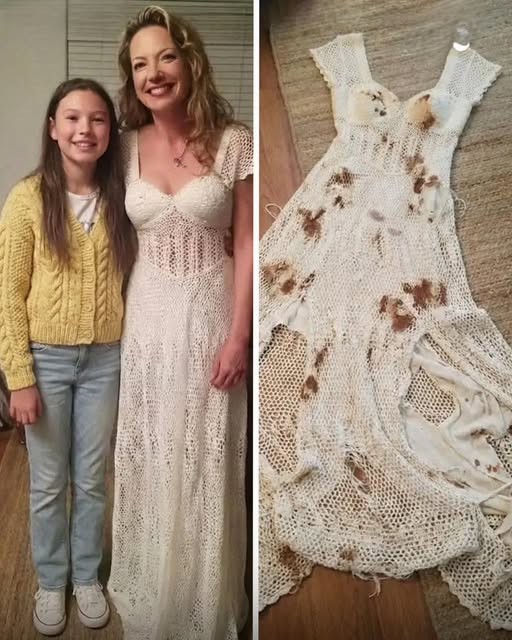
She stood there, trembling, her breath shallow, her eyes wide with a kind of disbelief that hadn’t yet turned into tears. And in her hands—no, on her body—was the dress. The dress she had made herself. Every stitch hand-knit with patience, with love, with quiet dreams of this exact day.
Now it hung in ruin.
The bodice had been torn open—not accidentally, not clumsily, but with intention. Yarn ripped apart in jagged lines that spoke of careful destruction. And across the soft white threads, blooming like a wound that refused to be ignored, was a deep, deliberate red stain.
For a second, I couldn’t breathe.
Joy didn’t just disappear in that moment—it sharpened. It turned into something cutting, something cold. The kind of feeling that slices through confusion and lands squarely in truth.
This wasn’t an accident.
This was cruelty.
A jealous sister-in-law. A quiet resentment that had finally found its moment. Clara had smiled all morning, played her part perfectly, moved through the house like she belonged to the celebration. And all the while, she had chosen this—chosen to take something sacred and try to make it small, to make it humiliating, to make my daughter feel like she didn’t deserve the day she had built with her own hands.
But she had miscalculated.
Because the moment I saw that dress—the torn threads, the stain that screamed louder than any accusation—the wedding stopped being about flowers, about seating charts, about whether the cake would arrive on time.
It became something else entirely.
A reckoning.
There are moments in life when everything clarifies at once. When the noise falls away and what matters stands alone, undeniable. This was one of those moments.
Clara’s act was meant to humiliate. To reduce love into something fragile and laughable. But what it revealed instead was something stronger than perfection could ever be.
Choice.
When Daniel walked into that room, I braced myself for hesitation—for questions, for doubt, for that flicker of uncertainty that can undo everything. But it never came.
He saw the dress. He saw Lily. And then he chose.
Instantly. Completely.
He didn’t ask if we were sure. He didn’t weigh stories or search for explanations that might soften what had been done. He simply believed us. And in that belief, he drew a line so clear it left no room for argument.
Clara was told to leave.
Not gently. Not diplomatically. She was told to go—and to take an apology with her on the way out, though no apology could stitch back what she had tried to destroy.
In that moment, the center of the day shifted.
It was no longer about a flawless ceremony or a perfect photograph. It wasn’t about whether the guests would whisper or whether the story would spread. It became about allegiance. About who stands with you when something precious is broken. About who chooses you when it would be easier not to.
And so we began again.
Not by replacing what was lost—but by working with it.
Lily and I sat side by side, the ruined dress pooled between us like something fragile but not beyond saving. Our fingers moved slowly at first, then with growing certainty. We didn’t try to erase the damage. We didn’t chase the illusion of perfection.
We rebuilt.
Thread by thread. Stitch by stitch.
We let the scars remain.
The torn places became patterns. The red stain softened, transformed—not hidden, but woven into the story of the dress itself. What had been an act of destruction turned into something else entirely: a map. A visible record of what we had endured, and what we refused to let define us.
By the time the music called us back, the dress was no longer what it had been.
It was something stronger.
When I walked down the aisle, I felt every uneven stitch against my skin. Not as a flaw—but as a promise.
A vow that had nothing to do with the ceremony ahead and everything to do with the choice already made.
I will not trade my child’s heart for anyone’s approval.
Not for family. Not for appearances. Not for the comfort of pretending nothing had happened.
The dress could be remade.
But this—this decision, this line drawn in the quiet aftermath of cruelty—was permanent.
And as I reached the end of the aisle, as I placed her hand into Daniel’s, I knew something with absolute certainty:
Clara had tried to turn love into something small.
But love, when chosen fully—when defended without hesitation—doesn’t shrink.
It becomes unbreakable.
I chose my daughter.
And the right man chose us both.