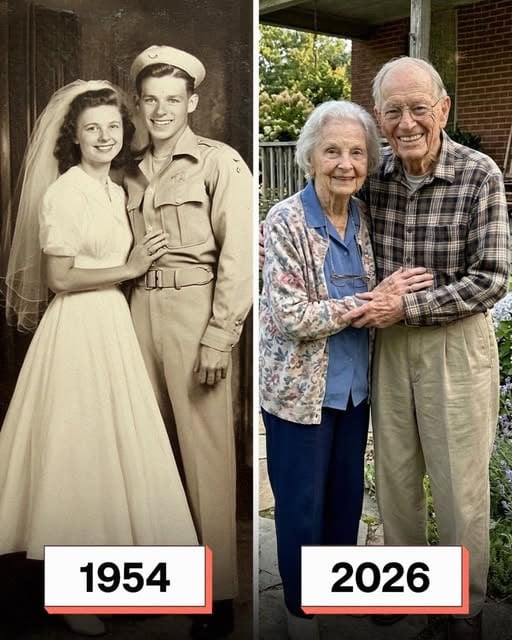
The ring was not mine.
Seventy-two years of marriage, a lifetime of mornings and nights intertwined, and in one shattering instant, the foundations of my world seemed to tremble. I stood beside my husband’s casket, the scent of lilies and polished wood heavy in the air, when a stranger in a faded army jacket approached me. Without a word, he pressed a small, worn box into my hands and disappeared almost as quietly as he had appeared. My fingers trembled as I lifted the lid—and inside, resting on a bed of velvet, was a delicate gold band that did not belong to me. In that moment, grief sharpened into suspicion. My mind raced through a lifetime of memories, searching for a hint, a misstep, anything that could explain how a man I had loved for decades could harbor a secret so intimate.
I had walked into Walter’s funeral believing our story was complete. Every chapter of our life together had been written, every page dog-eared with familiarity, every word etched into the rhythms of our shared days. Yet the sight of that small box told me I had been wrong. The ring was not evidence of a hidden affair or betrayal—it was a testament to something far more tender, far more human: a promise kept across time, a life interrupted by war, and a widow whose sorrow had been entrusted to my husband’s conscience.
The soldier who handed me the box—Paul, he later told me—spoke softly, almost reverently, of the young widow named Elena. Her husband had died in combat decades before, leaving her with a grief too heavy to bear alone. Walter had known her pain, had witnessed it in ways I would never fully comprehend. And in a gesture of loyalty that had defined him quietly for a lifetime, he had taken up a responsibility that was not his own. A promise to comfort, to honor, and to see through the final wish of a man who could not keep it himself.
For decades, Walter carried that unfinished duty like a smooth, weighty stone in his pocket, never burdening anyone with it, not because he doubted my heart, but because some promises are sacred, meant to be borne in silence. When his strength began to fade, he passed it to Paul, knowing the obligation would be respected, even if it remained invisible to the rest of the world.
As I knelt beside Walter’s grave and laid the gold band upon the cold earth, I realized something profound: our marriage had never been threatened by this secret. If anything, it had been deepened by it. I had not known every corner of my husband’s life, every quiet act of devotion that shaped him beyond my view, yet I finally understood the part of him that spent a lifetime honoring a promise no one else remembered. Love, I understood then, was not diminished by secrets—it was measured by the courage and constancy with which a heart could carry them.
In that moment, amidst the sorrow and the fading echoes of farewell, I felt the weight of seventy-two years not as a burden, but as a gift. Walter had loved, protected, and honored not only me, but the humanity that stretched beyond our own life together. And in that quiet understanding, grief softened into awe, and awe bloomed into a deep, enduring gratitude I would carry for the rest of my days.