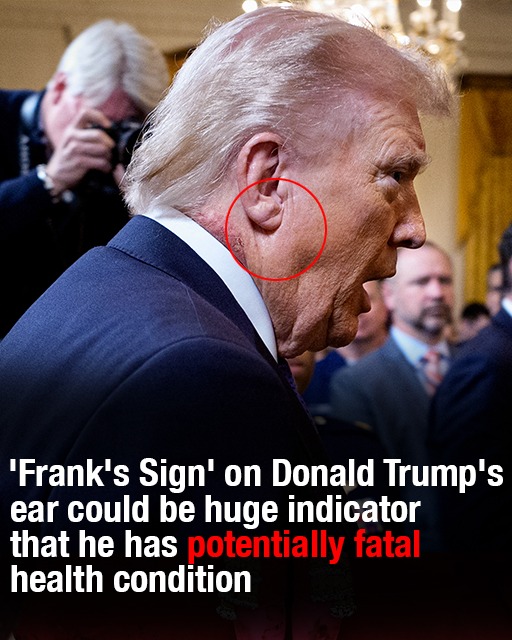
The photographs were impossible to look away from. Under the harsh, unflinching glare of the White House lights, a raw, angry rash appeared on President Trump’s neck—bright, irritable, and unmistakably real. Within hours, social media erupted. Speculation ran wild. Hidden illnesses. Secret cover-ups. Something far more sinister, lurking just beneath the surface. The White House doctor issued a swift, measured explanation, insisting it was nothing more than a “preventative skin treatment.” But in the court of online sleuths, no explanation is ever enough. Every detail was examined, dissected, magnified. Even a faint crease in the president’s earlobe—a tiny, almost trivial feature—was seized upon as a potential warning sign, a harbinger of deeper health concerns.
These images came from what should have been a moment of honor and ceremony: the Medal of Honor presentation. Yet instead of a celebration, the photos reignited long-simmering doubts about the well-being of a 79-year-old leader who has repeatedly claimed he is in peak health. Dr. Sean Barbabella’s words were calm, almost mundane, but they clashed violently with the storm of conjecture already brewing online. Every gesture, every slip of speech, every heavy-lidded pause in a meeting has been scrutinized, woven into a narrative suggesting that there might be far more going on than the public is allowed to see.
Voices like David Pakman’s pushed the conversation even further. Pakman drew attention to the faint diagonal line in Trump’s earlobe, citing research linking such markings to cardiovascular risk. He acknowledged the limits of such deductions, but in the fevered environment of public scrutiny, the idea took hold: a single crease, a tiny imperfection, as evidence of something much larger, much more ominous. Suddenly, a rash wasn’t just a rash. It became a symbol—a mirror reflecting the unease of a nation caught between trust and suspicion, transparency and secrecy, the image of a leader and the fragility of the man himself.
In the end, the photographs did more than capture a moment. They opened a window into the anxieties of a country obsessed with its commander-in-chief’s health, where every mark, every wrinkle, every fleeting imperfection becomes fodder for debate. The rash on the neck became less about dermatology and more about the precarious intersection of power, mortality, and the relentless search for truth in an era where nothing is taken at face value.