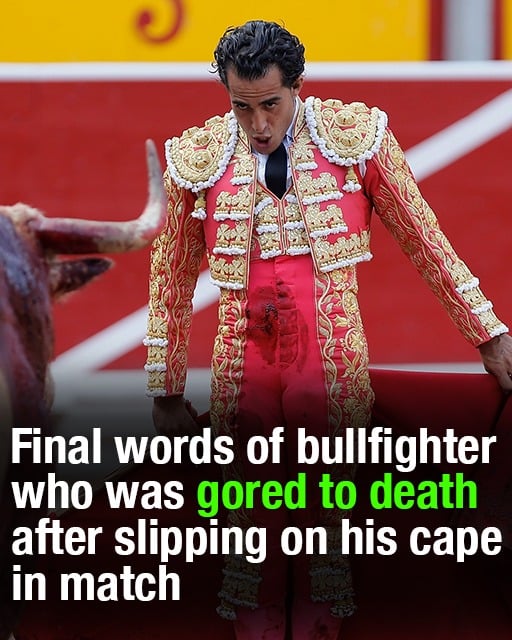
Blood soaked the sand before anyone could even process the horror unfolding in the arena. A master of the bullring, a man whose name had become synonymous with daring and precision, lay sprawled beneath the hot sun, gasping, eyes fixed on the sky as if searching for answers beyond human reach. The truth of what had just occurred hit him—and those around him—long before the medical team could act. Witnesses later recounted how his final, desperate plea haunted them: words that seemed to suspend time, a human voice clinging to life amidst chaos. A single misstep. A half-ton beast, majestic and merciless, executing instinctive fury. A sport that had always danced between art and annihilation revealed its darkest, most unforgiving side.
Iván Fandiño had spent decades defying the limits of mortality. To watch him in the ring was to witness poetry in motion, a dangerous choreography where every movement balanced on the razor’s edge of life and death. He was the torero who stepped into the arena when others hesitated, confronting bulls whose temperament was deemed too wild, too unpredictable, too lethal. Courage was his signature, and spectacle his medium. Yet in Aire-sur-l’Adour, even the bravest soul could not escape fate. One slip of the cape, one violent twist of horn, and the crowd’s cheers instantly morphed into a stunned, disbelieving silence.
Carried from the sand, his body battered but mind unclouded, Fandiño’s final words—“Hurry up, I’m dying”—were a chilling testament to the clarity with which he faced the inevitable. There was no denial, no bargaining, only an unflinching acknowledgment of the price of his life’s devotion. It was a moment that crystallized both the glory and the terror of a tradition steeped in blood, sweat, and admiration.
Across Spain and France, news of his death rippled like a shockwave, stirring grief, anger, and reflection in equal measure. Tributes poured in from fellow matadors, spectators, and even royalty, each framing him as a figure at once heroic and tragic—a living emblem of a culture where courage and mortality intersect in the harshest of terms. And yet, in the echo of the arena and in the conversations that followed, one question resurfaced with renewed intensity: in a pursuit defined by bravery, artistry, and ritual, can any achievement ever justify a life lost so publicly, so violently, in the name of tradition?
Iván Fandiño’s legacy is immortal not just in the annals of bullfighting, but in the uneasy awareness it leaves behind: that beauty and danger, art and death, can sometimes converge in ways that defy comprehension.