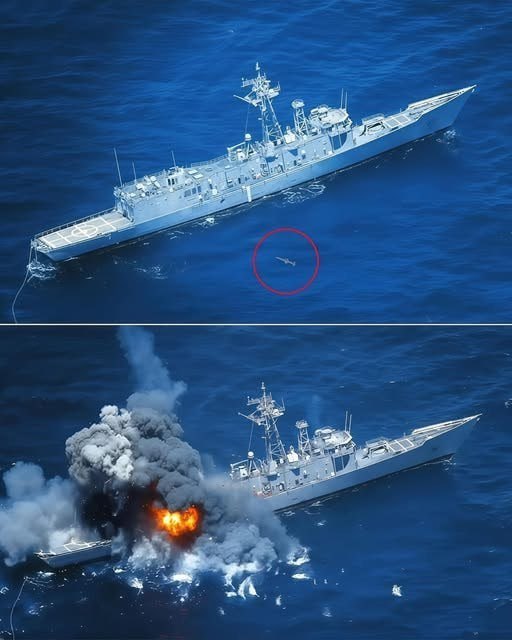
They didn’t lose her in battle. They chose to end her life. A proud Cold War frigate, once a fortress of steel and purpose, was led to her final resting place by the very Navy she had served for decades. She had survived storms, missiles that never reached her, tense standoffs with unseen submarines, and the slow wear of time—but no enemy could claim her. Instead, her fate was decided in quiet offices, on charts and spreadsheets, far from the roar of the sea. One last mission. One last missile. One last defiant cry before the ocean closed over her forever.
She was born into a world of tension, secrecy, and cold strategy. Commissioned in 1982, she was designed to stalk the shadowy threats of the deep, to guard convoys against invisible enemies, and to patrol waters where every ripple could hide danger. Named after Rodney Maxwell Davis, a Marine who gave his life to save his comrades, the frigate carried that legacy with every knot of speed, every creak of her hull, and every echo in her steel corridors. For decades, she roamed the world’s oceans—crossing stormy seas, shadowing submarines, training with allies, and quietly enforcing the fragile, unspoken rules that kept the nuclear age from spinning into catastrophe.
Inside her steel belly, generations of sailors lived, worked, and sometimes feared for their lives. They painted her decks under blistering suns, cursed her engines when they broke, and trusted her hull to hold them together when the world felt unsteady. Each rivet was a promise, each watch a ritual. She was more than metal—she was a home, a protector, a constant amid uncertainty.
And yet, the end came not with battle but with purpose. The Navy stripped her bare—hazardous materials removed, sensitive systems dismantled, leaving only the skeletal echo of what she had been. Then, with surgical precision, a Harpoon missile struck. It tore into her with neither hesitation nor fury, a clean execution for a ship that could no longer defend herself. Those who had called her home watched, some in disbelief, some with tears, as years of sweat, fear, laughter, and pride sank beneath the waves.
It was a sacrifice of memory and muscle, of history and heart. Her death was not for glory, not for vengeance, but for the cold calculus of the future—a lesson, a test, a warning. The ocean swallowed her, but her story lingered: of courage lived in steel corridors, of service carried across uncharted waters, and of the quiet, inexorable passage of time that spares no one, not even a legend of the sea.