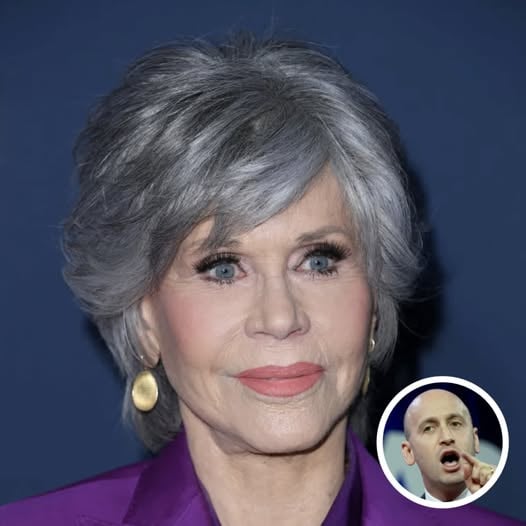
Jane Fonda had hoped that chapter of her life—the one that haunted her for decades—was finally behind her. The infamous photo, the scorned radio broadcasts, the relentless public outrage—it all felt like history, something past, a wound she had spent years trying to close. She had apologized repeatedly, calling the choices of her youth “a huge mistake,” yet standing firm that her opposition to the Vietnam War was principled. She had moved on, or at least tried to.
Then, in a single moment on live television, Stephen Miller tore that fragile closure to shreds. His words were unyielding, sharp, and merciless. He called her “treasonous,” insisting that America could never forgive, never forget. The audience winced. Social media erupted. And for Fonda, the old wounds—some she had carried silently, some she had bared to the world—yawned open again, raw and bleeding. The question that hung in the air was haunting: how long can a person be held accountable for choices made in the heat of history?
Miller’s attack struck at a memory that had never fully healed for many Americans. For Vietnam veterans, the image of a young, smiling actress seated atop a North Vietnamese anti-aircraft gun was not just a controversial photo—it was a symbol of betrayal. At a time when soldiers were risking life and limb, the photo and Fonda’s outspoken critiques of U.S. policy felt like a dagger to the heart of a nation’s conscience. The helmet she wore, the broadcasts she recorded, the defiance she embodied—they became shorthand for a country questioning its own soldiers, for a public grappling with anger and shame, for a debate over loyalty that lingered long after the war ended.
Decades later, Fonda has repeatedly tried to reconcile that moment with the life she built afterward. She has apologized, reflected, and even defended her right to dissent—a fundamental American principle—but Miller’s decision to resurrect that history is less about Vietnam than about today. It’s about the culture wars, the unending debate over who deserves forgiveness, who is forever branded, and who gets to control the narrative of patriotism in modern America.
In the collision of memory, anger, and redemption, Jane Fonda has become a battlefield all over again. Her story—once defined by a single, incendiary photograph—now exists in the larger struggle over history, accountability, and the shifting lines between courage and condemnation. The question remains: can the past ever truly be left behind, or will it always be dragged into the light, ready to wound again?