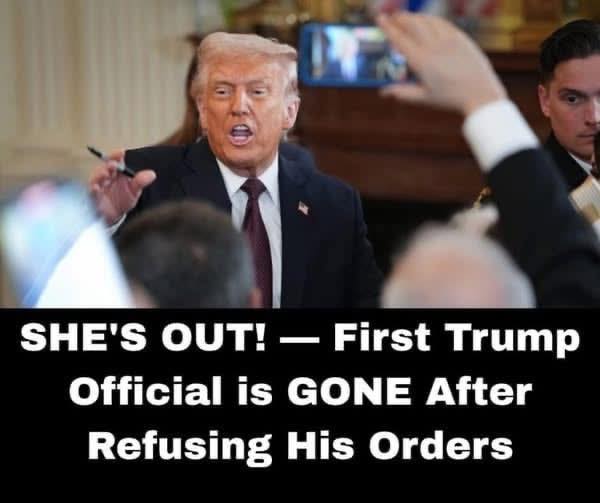
A powerful woman crossed a line—and within what felt like a single political heartbeat, she was gone.
No drawn-out investigation. No slow, bureaucratic fade into obscurity. Just one tense confrontation behind closed doors, one refusal to fall in line, and suddenly her place inside Donald Trump’s orbit evaporated almost overnight.
In Washington, where power is rarely exercised quietly and loyalty is often treated like currency, the story has spread with electric speed. Staffers whisper about loyalty tests. Veteran operatives debate whether fear is becoming the dominant management style. And across the capital’s corridors, one question hangs heavy in the air: who is truly in charge—and what happens when someone dares to push back?
To some observers, the episode is simply an example of political discipline. In their eyes, administrations—especially ones driven by strong personalities—run on unity. A president sets the course; the team executes the mission. When someone publicly or privately resists that direction, the consequences are inevitable.
But to others, the moment carries a darker undertone.
They see something else entirely: a warning shot. A signal that even seasoned professionals with years of experience can find themselves abruptly cast aside if they challenge the wrong directive at the wrong time.
Those closest to her insist the clash was not about ego or rebellion. They say it began with a moment of hesitation—a pause driven by principle rather than defiance. When an order arrived that raised legal or ethical concerns, she reportedly did what many career officials believe they are duty-bound to do: she questioned it. She raised a flag. She asked for clarification.
Inside government, that kind of pushback has long been considered part of the process.
But this time, according to those watching the fallout, it triggered a collision between two fundamentally different views of authority.
Her allies describe her as a disciplined professional who believed her responsibility was not just to follow orders but to protect the system itself. In their telling, she saw potential risks and tried to slow things down long enough for a deeper review. The price of that caution, they say, was her position.
Trump’s defenders tell a very different story.
From their perspective, the issue is not conscience but control. Elections, they argue, are meant to settle the question of direction. When voters choose a leader—especially one as politically dominant as Trump—they are choosing a vision. Staff members, they say, are not elected policymakers; they are the machinery that makes that vision real.
Seen through that lens, hesitation is not prudence. It is obstruction.
And so the removal came swiftly.
Within days—perhaps hours, depending on which account you believe—plans were already underway to replace her. The speed of the transition was striking even by Washington standards. In a city famous for slow processes and endless deliberation, this decision moved like a lightning strike.
That speed is precisely what has fueled the debate now unfolding across the political landscape.
Was it decisive leadership?
Or was it something more chilling—a signal that dissent, even quiet dissent, carries a steep price?
For the ambitious insiders who populate Washington’s power structure, the lesson has been impossible to ignore. Staffers in government offices, campaign headquarters, and policy think tanks are quietly studying the moment, trying to decode its meaning.
Some see a clear message: loyalty must come first.
Others see a warning: speak carefully—or not at all.
In private conversations across Capitol Hill and beyond, people are doing the same calculation. How far can you go in questioning a decision before it becomes disloyalty? When does professional judgment turn into political defiance? And perhaps most importantly—what happens to those who choose conscience over compliance?
The answers remain unsettled.
What is clear is that her removal has become far more than a personnel decision. It has evolved into a kind of political Rorschach test, revealing how Americans themselves interpret power.
For some, the story affirms a belief that strong leaders must enforce discipline to maintain control.
For others, it raises troubling questions about the shrinking space for disagreement inside government.
And in the shadow of that tension, a deeper transformation may already be underway.
Because the rapid replacement of one official is not merely about filling a vacancy. It is about defining a culture—about establishing the unwritten rules that shape how people behave within a political machine.
Inside Trump’s world, those rules may now feel clearer than ever.
Speak up—and risk exile.
Stay silent—and survive.
Somewhere between those two choices, the next chapter of his political operation is already being written.