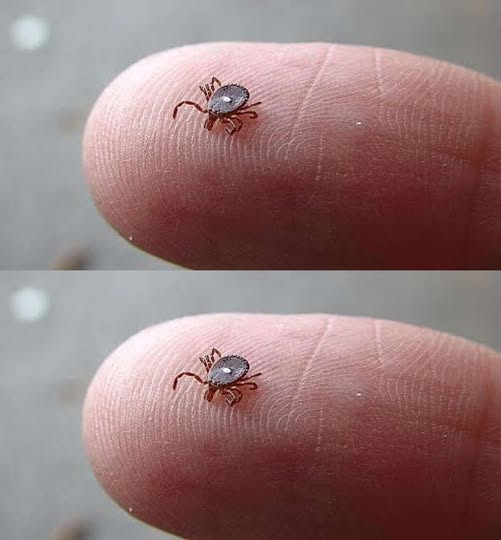
The terror hit before the pain.
One second I was yanking the cord on my stubborn old lawnmower, sweat stinging my eyes, grass clippings flying in lazy green spirals. The engine coughed, roared, and I glanced down—just in time to see it.
Clinging to my ankle like it had paid rent.
Not a mosquito. Not a fleck of dirt.
A lone star tick—small, flat, unmistakable—locked in with quiet determination.
My skin crawled before my brain caught up. My pulse spiked. In that split second, every late-night article, every cautionary post, every horror story I’d ever skimmed online came flooding back like a siren. It felt absurd to be afraid of something so tiny… and yet there it was, attached to me, feeding.
I didn’t scream—but my mind did.
That tiny white-dotted parasite felt like a loaded threat pressed against my skin. My hands trembled as I grabbed tweezers, trying to remember the instructions I’d read a dozen times: steady grip, close to the skin, no twisting, no panic. The moment stretched thin as wire. When it finally released, I felt both victorious and violated.
I dropped it into a container, sealed it tight, and stared at it—this minuscule creature that had just hijacked my entire nervous system.
Then came the spiral.
Lyme disease. Fevers. Rashes. Joint pain. Fatigue that lingers for months. And the one that chilled me most: strange, life-altering allergies linked to lone star ticks. Every symptom I’d ever heard of replayed in a grim montage. I scrubbed the bite clean, washed my hands twice, then once more for good measure. My dog wagged his tail, blissfully unaware, and I forced myself to act normal—for his sake, if not my own.
But normal had already shifted.
The days that followed were strangely split in two. On the outside, life continued—emails answered, lawn trimmed, dinners cooked. On the inside, a quiet dread ticked louder than any clock. I checked the bite every few hours, memorizing the landscape of my own skin. Was that redness new? Was that spot bigger? Did that freckle look different yesterday?
I wrote down the date. I researched incubation periods. I monitored every twinge in my muscles, every flicker of fatigue, every chill in the evening air like a detective afraid of confirming the worst.
Each ache felt suspicious. Each headache carried a question mark.
But somewhere between the panic-checks and late-night searches, something began to shift.
Fear thrives in the unknown. And slowly, the unknown became information.
I learned what symptoms truly mattered and which ones were just anxiety wearing a mask. I discovered how to remove ticks properly, how long they typically need to transmit disease, when to call a doctor and when to breathe. I researched yard maintenance strategies—shorter grass, cleared leaf litter, safe repellents. I ordered protection for my dog. I began checking my ankles like a ritual after every yard chore.
The fear didn’t vanish.
It changed.
It transformed from blind panic into respect. Awareness. Preparedness. The kind that hums quietly in the background instead of screaming in your ear. I realized that nature isn’t malicious—it’s indifferent. And indifference demands attention.
That tiny tick reminded me how quickly vulnerability can find you in your own backyard. But it also taught me something steadier: panic is powerful, but knowledge is stronger.
Now, when I step into the grass, I’m not naïve—but I’m not frozen either. I’m alert. Intentional. Equipped.
And if there’s ever a next time, I won’t be caught off guard by something so small carrying such outsized fear.