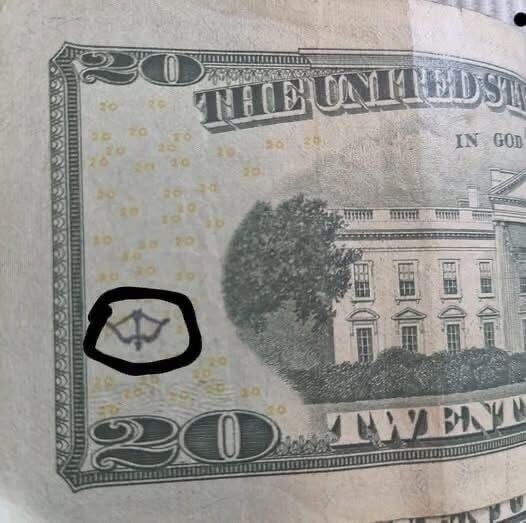
Most of us handle it every day, sliding it across a counter or unfolding it from a wallet, yet few ever pause to see it. The eagle on the $20 bill isn’t just decoration—it’s a silent manifesto, a miniature blueprint for how a nation thinks about survival, power, and peace. Every detail—the curve of a feather, the bundle of arrows, the number of leaves—was chosen deliberately. Even the direction the eagle gazes carries meaning, though almost nobody notices.
Take a moment to study the Great Seal embedded in the bill. At first glance, it seems like elegant artistry, the kind meant to impress or convey authority. But look closer, and the design reveals itself as a conversation frozen in ink, a debate encoded for anyone willing to read it. In one talon, the eagle grips a cluster of arrows. They are bound together, a subtle reminder that true strength is not just personal or solitary—it only exists when it is shared, coordinated, and organized. In the other talon, it carries an olive branch, the age-old emblem of peace. Notice the subtle imbalance: there are more leaves than arrows, as if to whisper a preference for diplomacy over aggression.
And then there’s the eagle’s head, turned deliberately toward the olive branch. This is no accident. The nation’s founders were far from naïve; they understood that survival often demands vigilance, preparation, and even the readiness to fight. But in the same breath, they enshrined a moral compass: let peace lead, let force follow only when necessary, and remember that real power lies in the courage to restrain oneself.
So, each time that $20 bill passes from hand to hand—in gas stations, grocery lines, rent payments, and tipping jars—it carries a quiet lesson. It’s a reminder that a country’s greatest strength may not come from its weapons, armies, or borders, but from restraint, cooperation, and the courage to seek peace even when the world around it seems poised for conflict. In that small, intricate design lies an enduring argument: power is not just what you wield; it’s also how wisely you choose to wield it.