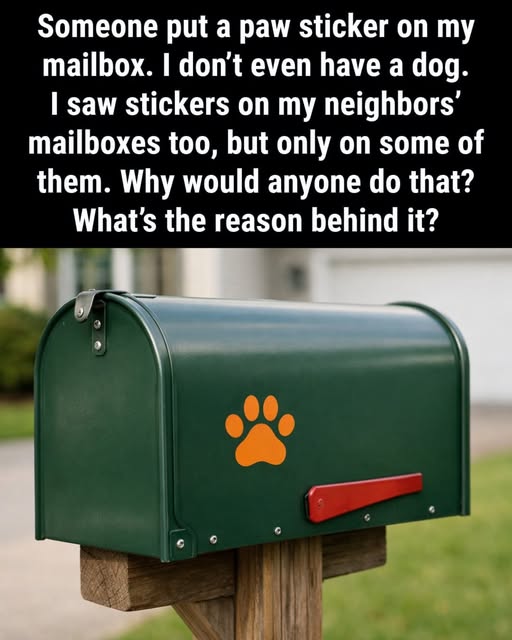
The first time I noticed the small orange paw print on a mailbox, I smiled.
It looked harmless—almost charming. A playful little sticker, the kind you’d expect to see in a child’s scrapbook or on a vet clinic window. It added a splash of color to an otherwise ordinary mailbox. I assumed it was decorative, maybe a proud nod to a beloved family pet inside.
By the third mailbox, though, the feeling shifted.
The repetition made it impossible to ignore. The same bright paw. The same deliberate placement. It didn’t feel random anymore. It felt intentional. And suddenly, what once seemed cute began to feel like a quiet warning—one I had somehow never learned to read.
What I eventually discovered about those stickers didn’t just change how I see dogs. It reshaped how I think about safety, about responsibility, and about the silent calculations strangers make when they step onto our property. It forced me to confront a truth I had never considered: that for some people, approaching a front door is not routine—it’s a risk.
That tiny orange paw print wasn’t decoration at all.
It was survival.
The sticker was part of a pilot program introduced by the United States Postal Service—a discreet system designed to protect mail carriers. The bright paw served as a silent code, alerting carriers that a dog lived on the property or even next door. It allowed them to prepare themselves before stepping out of their vehicle. To stay alert. To move cautiously. To avoid being caught off guard.
Because even the sweetest, most well-trained dog can become unpredictable when a stranger crosses an invisible boundary.
To us, it’s our home. To a dog, it’s territory.
And to a mail carrier, it can become a place where a routine delivery turns into an emergency in seconds.
Long after the pilot program officially ended, many of those stickers remained. Faded by sun and rain, clinging stubbornly to metal mailboxes, they became ghostly reminders of something most of us rarely think about: thousands of mail carriers experience dog-related incidents every year. Not because dogs are “bad,” but because instinct, protection, and fear can override training in a heartbeat.
Today, the bright decals have largely been replaced by digital alerts in handheld scanners. Technology now does what those paw prints once did—flagging addresses where dogs may be present. The system is more modern, more efficient.
But the message hasn’t changed.
Behind every package left at your door is a layer of unseen caution. Behind every cheerful wave from the curb is a person who has already assessed escape routes, listened for barking, and hoped the gate latch holds.
Your everyday delivery runs on trust.
Trust that a dog is secured.
Trust that a gate is closed.
Trust that someone inside understands the risk.
Leaving that old orange sticker in place isn’t paranoia. Posting a simple “Dog Inside” sign isn’t overreaction. Bringing your dog indoors during delivery hours isn’t inconvenience.
It’s solidarity.
It’s a quiet acknowledgment that while we see our pets as family, someone else may encounter them in a moment of heightened instinct and vulnerability. It’s a small but meaningful way of saying: I understand the risk you take to bring life to my mailbox. I respect it. I won’t pretend it isn’t there.
That little orange paw print may look small.
But its message is anything but.