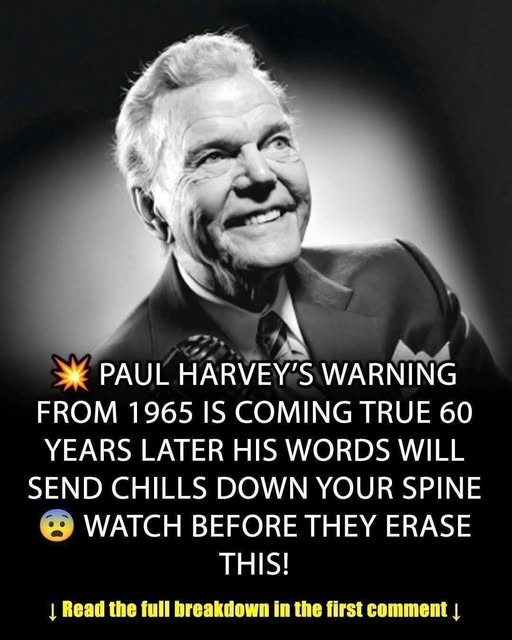
Memories like these don’t simply fade into the background of time; they linger, glowing softly at the edges of your thoughts, returning when you least expect them. They don’t haunt in a sorrowful way—but in the gentlest, most beautiful sense. A crackling radio humming in the corner of the living room. The faint scent of polished wood and warm afternoons. Your mother’s quiet, knowing smile as she paused to listen. And above it all, a voice—steady, deliberate, almost prophetic—filling the space as though it understood the future long before the rest of us could imagine it.
Paul Harvey didn’t merely deliver the news. He seemed to see beyond it. Where others reported events, he traced their consequences. Where others described the present, he hinted at what was waiting just around the bend. He spoke of technology that would shrink the world, of unrest simmering beneath polite headlines, of courage rising in unexpected places, and of complacency creeping in when vigilance waned. His words felt measured, careful, almost fatherly—never rushed, never careless. Listening to him wasn’t passive; it was participatory. He invited you to lean in, to connect the dots, to consider what it all meant.
Those afternoons were more than routine—they were formative. They were a quiet apprenticeship in how to listen deeply and think critically. As his voice threaded through the room, it wove itself into the very fabric of memory: your mother’s gentle presence beside you, the hum of the radio tubes warming, the golden light slanting across the carpet. History no longer felt like something locked in distant textbooks. It was alive, unfolding in real time, and somehow you were being prepared to witness—and understand—it.
When he spoke of learning machines and instant communication—voices traveling invisibly through air and wire—it sounded like fascinating speculation. Imaginative. Almost theatrical. Yet here we are, living in the world he described with uncanny clarity. The once-distant possibilities have become our daily realities. And in that realization there’s a quiet awe, even a shiver: he wasn’t just imagining; he was anticipating.
Revisiting those broadcasts now is not merely an exercise in nostalgia. It is a reckoning. A measuring stick for how far we’ve traveled—and perhaps how closely we’ve followed the trajectory he warned about. You hear again his caution about indifference, about the subtle dangers of comfort and distraction. You recognize how easily noise can drown out wisdom. And you understand more fully what he was urging all along: attention, responsibility, engagement.
The recordings have become more than archival artifacts. They are bridges. Bridges between you and your mother, between innocence and awareness, between prediction and fulfillment. They carry the warmth of shared moments and the weight of unfolding truth. In his cadence—measured, unmistakable—you still hear the invitation: stay awake. Stay curious. Refuse to drift into complacency. The story is not finished yet.
And perhaps that is the most powerful part of all. Those memories are not just reflections of what was; they are reminders of what is still possible. The radio may have quieted, the living room may have changed, but the charge remains the same. We are still listening. We are still learning. And we are still writing the part of the story that has yet to air.