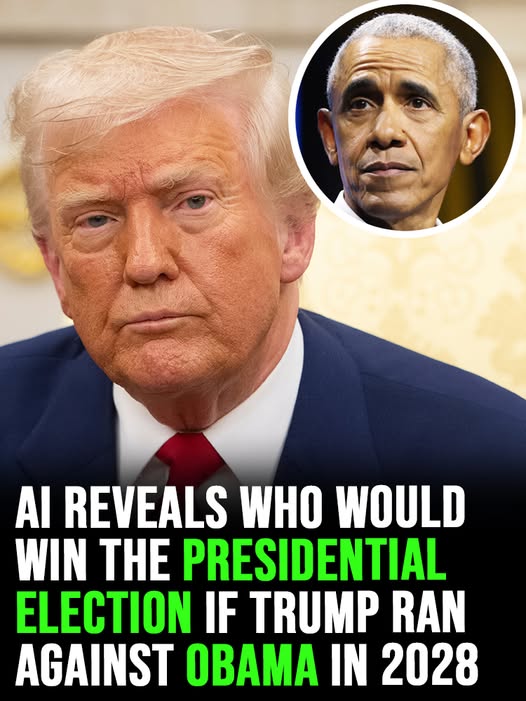
The question isn’t meant to be real. It’s a thought experiment—an exercise in political imagination. And yet, it feels real enough to send a tremor through Washington.
Picture it: the year is 2028. The constitutional guardrails are gone. No 22nd Amendment. No term limits. Just the raw, combustible force of political will. On one side stands Donald Trump, the master of disruption, grievance, and relentless momentum. On the other, Barack Obama, the calm rhetorician of hope and institutional faith. Two former presidents. Two defining figures of a political era. Both back on the ballot.
It is the ultimate rematch that never was — and, under current law, never can be.
In this imagined 2028 showdown, the AI doesn’t forecast a razor-thin photo finish. Instead, it paints a portrait of a nation worn down by permanent crisis. Years of polarization. Economic anxiety. Culture wars amplified by algorithm. Institutional trust eroded by scandal, spectacle, and fatigue. The electorate in this scenario isn’t hungry for revolution. It’s tired. It isn’t looking for a savior. It’s looking for a ceasefire.
Within that landscape, the model tilts toward Obama — not necessarily as the more charismatic candidate, nor even purely on ideological grounds — but as the steadier figure. The race, in this telling, becomes less about left versus right and more about stability versus disruption. Continuity versus combustion. A referendum not just on policies, but on temperament.
Trump’s political brand remains powerful. His combative, grievance-fueled style continues to electrify a fiercely loyal base that views him as a disruptor of entrenched elites and a blunt instrument against a system they distrust. In rallies and headlines, he still dominates the emotional center of American politics. But the AI assumes something broader is shifting beneath the noise: a wider electorate increasingly wary of endless escalation, of politics as permanent emergency, of drama without resolution.
The model imagines suburban moderates, exhausted independents, and younger voters raised in the shadow of constant turmoil leaning toward what feels predictable, procedural, and calm. Not because they are inspired — but because they are drained.
And yet, this entire scenario rests on a constitutional impossibility.
The Twenty-second Amendment to the United States Constitution bars any individual from being elected president more than twice. Repealing it would require a constitutional overhaul of staggering proportions: two-thirds of Congress and ratification by three-fourths of the states. In today’s fractured political climate, that threshold borders on fantasy.
Which is precisely why the thought experiment matters.
It is less a prediction than a mirror.
By imagining a world without term limits, we are forced to confront a deeper question about power and democracy. Do Americans value guardrails — even when those limits block leaders they admire? Or would they prefer the freedom to choose the same figure again and again, trusting voters rather than constitutional design to determine when enough is enough?
At its core, the hypothetical 2028 clash isn’t about Trump versus Obama. It’s about exhaustion versus endurance. It’s about whether a nation fatigued by crisis craves stability more than spectacle. And it’s about whether democracy is strongest when it limits its champions — or when it allows them to return, indefinitely, at the ballot box.
The scenario may never be real. But the questions it raises already are.