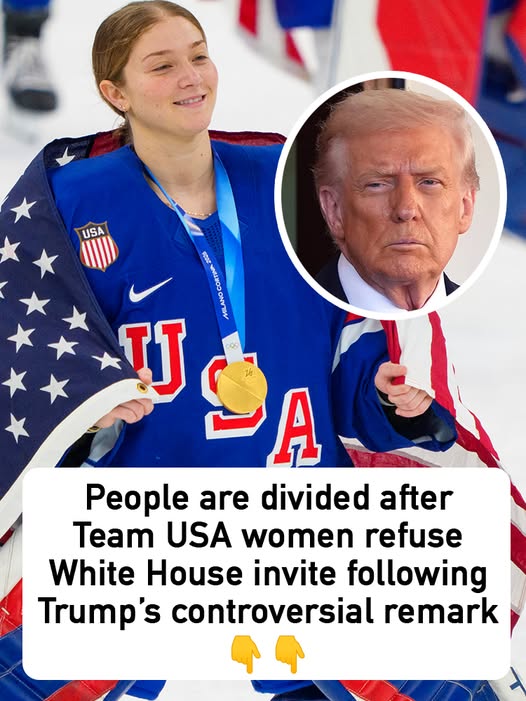
The men’s and women’s hockey teams departed Milan draped in gold, their victories echoing far beyond the arena walls. They had skated through pressure, expectation, and the weight of national pride to claim championship titles that will be etched into sporting history. For a fleeting moment, the story seemed simple: two teams, one nation, triumph. But as the celebrations continued back home, a different kind of contest began to unfold — one not fought on ice, but in words, perceptions, and public reaction.
When former President Trump placed a congratulatory call to the men’s team, it was framed as a customary gesture — a nod to excellence and national pride. Yet it was his offhand remark about needing to invite the women’s team as well “or risk impeachment” that quickly shifted the tone. In a country already attuned to parsing every syllable from public figures, the comment landed with a thud for some and a chuckle for others. To supporters, it was clearly tongue-in-cheek, an exaggerated joke delivered in familiar style. To critics, however, it felt like something more telling — a reminder that women’s achievements, even at their most undeniable, are too often accompanied by qualifiers, comparisons, or caveats.
The women’s response was measured and unmistakably composed. In a formal statement, they expressed gratitude while respectfully declining an invitation to the White House, citing prior academic and professional commitments. Their words were polished, gracious, and carefully considered. Yet the decision immediately became a Rorschach test for a divided audience. Admirers saw quiet resolve — a team standing confidently in its autonomy, neither confrontational nor apologetic. Skeptics interpreted the move as an unnecessary politicization of what could have been a unifying celebration.
In truth, the episode underscored a familiar tension that elite athletes often navigate. They are celebrated as heroes, held up as embodiments of national unity and perseverance — yet they remain individuals with personal convictions, schedules, and boundaries. The expectation that they must seamlessly embody both symbol and citizen can create a narrow corridor in which any choice risks being overinterpreted. For the women’s team, declining the invitation was neither a grand protest nor a casual snub; it was a decision made on their own terms, shaped by their commitments and their sense of agency.
Long after the debates fade and the headlines move on, the championships themselves will endure. The medals will gleam in display cases, in hallways, and in memory, testaments to skill, discipline, and teamwork. But alongside that legacy will remain another narrative — one about voice, visibility, and the subtle ways recognition can become complicated. In Milan, both teams proved themselves champions. In the days that followed, the women demonstrated something equally lasting: the resolve to define their own place in the spotlight, even when that light burns brightest.